
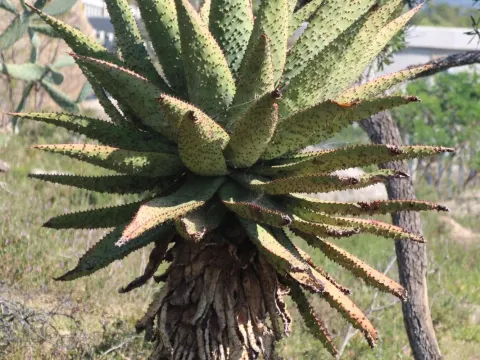
Aloe spectabilis
Aloe spectabilis
Aloe spectabilis belongs to the Asphodelaceae family and is known for its resilient nature. In agricultural and greenhouse settings, the primary method of propagation is vegetative, utilizing offsets or basal shoots that develop around the parent plant.
What the section contains
Aloe spectabilis
Seed propagation is also possible but is generally reserved for breeding programs. Seeds require a well-draining, sandy substrate and a consistent temperature of about 22–25 degrees Celsius to germinate successfully, often taking several weeks to show growth.
The optimal time for transplanting and propagation is during the spring season. As the plant enters its active growth phase, it exhibits a higher success rate in root development and establishes itself more efficiently in fresh soil.
Containers must be prepared with adequate drainage holes. Given the succulent nature of the plant, water stagnation is a primary concern, and using a layer of inorganic material like perlite or gravel at the bottom is highly recommended.
Once established, the young plants require a period of stabilization with bright, indirect sunlight. Over the first few weeks, moisture levels should be monitored closely to ensure the roots take hold without the risk of rot.
Native to Southern Africa, Aloe spectabilis thrives in high-light environments. In indoor or greenhouse cultivation, it is essential to provide as much natural light as possible to maintain the plant's structural integrity and characteristic leaf coloration.
The ideal soil composition should be porous and slightly acidic to neutral. A mixture consisting of two parts loamy soil, one part leaf mold, and one part coarse sand is standard, providing the necessary aeration for the root system.
During the growing season, the plant prefers temperatures between 20 and 28 degrees Celsius. A winter dormancy period, with temperatures kept between 12 and 15 degrees Celsius, is beneficial for the plant's health and eventual flowering cycle.
Watering should be deep but infrequent. It is crucial to allow the substrate to dry out completely between waterings to prevent the development of soft rot, which is the most common cause of mortality in indoor succulents.
Humidity is not a limiting factor for this species; it is well-adapted to arid conditions. Spraying the foliage is not necessary and should be avoided, as trapped moisture in the leaf axils can promote fungal infections.
The most significant threats to Aloe spectabilis are root and stem rots caused by excessive moisture. If the soil remains soggy for extended periods, the plant's tissue may become soft and discolored, indicating urgent need for remedial action.
Common pests include mealybugs and scale insects. These pests feed on the plant's sap and can significantly weaken its structure. If left untreated, they can lead to secondary infections and severe stunted growth.
Spider mites can also become an issue in environments with poor air circulation and low humidity. Monitoring the undersides of the leaves is critical for early detection and prevention of widespread infestations.
Prevention involves maintaining good hygiene around the plant and ensuring proper spacing between individuals. Removing dead or necrotic leaf tissue helps eliminate potential harborages for pests and fungal spores.
If an infestation is detected, physical removal using an alcohol-soaked cotton swab or the application of specific horticultural oils and systemic insecticides is recommended to manage the pest population effectively.