
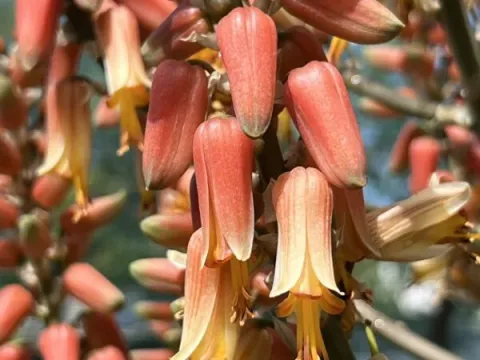
Aloe sabaea
Aloe sabaea
Aloe sabaea is a unique tree-like succulent belonging to the Asphodelaceae family. In its natural habitat, this species can reach a height of 3-5 meters, forming a robust, branched trunk covered with remnants of dry leaves.
What the section contains
Aloe sabaea
Native to the mountainous regions of Yemen and Saudi Arabia, this rare plant grows on rocky slopes. The culture is perfectly adapted to an arid climate with extremely high temperatures and water scarcity.
For successful cultivation, well-drained sandy or rocky soils with low organic content are required. The plant strictly does not tolerate water stagnation, so the substrate must ensure rapid moisture drainage to prevent root rot.
Under agrotechnical conditions, the crop requires maximum bright sunlight. If light is insufficient, the stems become brittle, lose density, and their decorative and quality characteristics are significantly reduced.
The temperature regime should be consistently high without sharp fluctuations. The plant is sensitive to freezing temperatures and damp cold, making cultivation in temperate regions possible only in protected ground.
The primary threats when growing Aloe sabaea include root and stem rots, which occur when watering regimes are disrupted or when overly dense, non-aerated soil mixtures are used.
Among pests, mealybugs and scale insects pose the greatest danger, as they localize in leaf axils and on the stem surface. Their presence leads to the deformation of young tissues.
Spider mites can affect the crop under conditions of critically low air humidity in indoor spaces. Regular inspection of the plants allows for the early detection of parasite colonies.
Disease prevention involves strict adherence to watering intervals, allowing the substrate to dry out completely. Systemic fungicides are recommended only when clear signs of fungal infection are present.
The biological resistance of the species to pests is quite high; however, under unfavorable conditions, weakened specimens become targets for secondary infections.