
Aloe vera
Aloe officinalis
Aloe vera (Aloe officinalis) is a succulent plant species belonging to the Asphodelaceae family. Native to arid regions, it is uniquely adapted to high-temperature environments with low water availability, making it a sustainable crop for semi-arid zones.
What the section contains
Aloe vera
The crop requires full sun exposure to flourish and maintain the necessary concentration of secondary metabolites in its leaves. In commercial cultivation, sites with 8-10 hours of direct sunlight are preferred to maximize biomass production.
Soil quality is paramount; Aloe vera demands well-draining, sandy-loam soils with a pH ranging from 7.0 to 8.5. Heavy soils must be amended with perlite or coarse sand to prevent waterlogging, which is the primary cause of root failure.
Temperature management is critical as the plant is extremely frost-sensitive. Optimal vegetative growth occurs between 20°C and 30°C. If temperatures drop below 5°C, the plants must be moved to protected greenhouses to avoid tissue necrosis.
Water management involves the principle of deep watering followed by a drying period. The soil must be allowed to dry out completely between irrigation cycles to simulate the natural desert environment and prevent fungal growth.
Root rot, primarily caused by Phytophthora or Pythium species, is the most devastating disease in commercial Aloe farming. It manifests when soils remain saturated for extended periods, destroying the plant's vascular system.
Mealybugs are the most common insect pests, clustering in the leaf axils and feeding on the sap. Their presence weakens the plant and promotes the growth of sooty mold, which impairs photosynthesis.
Spider mites represent another threat, particularly in hot and dry greenhouse environments. They cause stippling and yellowing of the leaves, reducing the aesthetic and medicinal quality of the harvested material.
Leaf spot diseases, caused by various fungal pathogens, appear as dark, sunken lesions on the leaves. These often occur when high humidity is combined with poor airflow, requiring immediate removal of infected foliage.
Integrated Pest Management (IPM) strategies, including the use of neem oil and biological predators, are recommended to control infestations while maintaining the purity required for medicinal and cosmetic applications.
Commercial harvesting of Aloe vera should only commence when the plants are at least three to four years old. At this stage, the leaves have achieved sufficient size and chemical maturity to be useful for extraction.
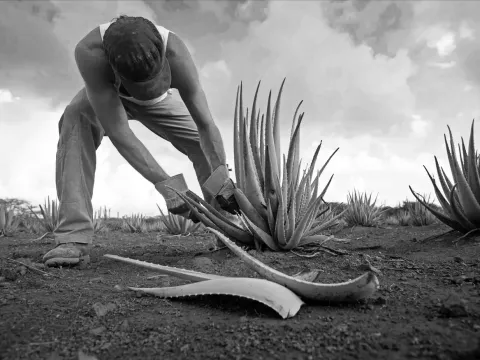
The harvesting process involves hand-cutting the mature, fleshy outer leaves. The cut must be made close to the stem, ensuring the knife is sanitized to prevent cross-contamination between individual plants.
Immediate processing is necessary after the harvest. The leaves must be washed and filleted to extract the inner clear gel, which oxidizes rapidly if left exposed to air and light for too long.
Harvesting is typically performed in the early morning to ensure the highest water content and enzyme activity in the leaf tissues. This timing optimizes the efficiency of the post-harvest extraction process.
Sustainable harvesting cycles allow the plant to continue producing new foliage for over a decade. By rotating harvests and allowing sufficient recovery time, growers can ensure long-term profitability and high-quality yield.