
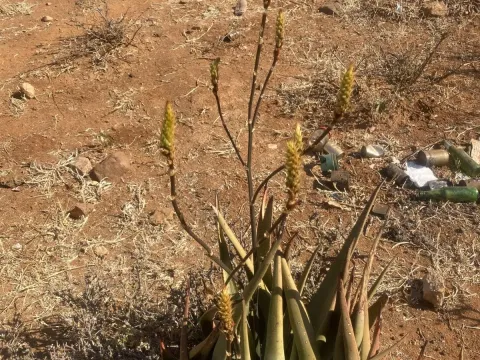
Aloe wickensii
Aloe wickensii
Aloe wickensii is a perennial succulent plant belonging to the Asphodelaceae family. This species is native to South Africa, specifically within the Limpopo and Mpumalanga provinces, where it thrives in rugged, mountainous, and rocky environments. It has evolved to survive in habitats with limited soil depth and extreme sun exposure.
What the section contains
Aloe wickensii
The plant is characterized by a rosette of succulent, lanceolate leaves that often exhibit a blue-green hue and armed margins. Its most distinct feature is the inflorescence, which consists of tubular bicolored flowers. These flowers are highly valued for their ornamental appeal, often featuring striking gradients from pink to creamy yellow.
Cultivation of Aloe wickensii requires strict adherence to soil drainage standards. Because it is a mountain-dwelling succulent, it cannot tolerate "wet feet." A well-aerated substrate composed of pumice, coarse sand, and a minimal amount of organic matter is recommended to mimic its natural mineral-rich, rocky habitat.
This species demands full sun to maintain its structural integrity. Inadequate light levels will cause the plant to etiolate, losing its compact form. While it is drought-tolerant, supplemental watering during the growing season is beneficial, provided that the soil is allowed to dry out completely between irrigation sessions.
The primary economic and horticultural application for this species is in decorative landscaping and botanical collections. It is particularly well-suited for xeriscaping in arid climates, where its high drought tolerance makes it a sustainable choice. In colder regions, it is popular as a container plant in greenhouses and bright indoor spaces.
Common health issues for Aloe wickensii include fungal infections resulting from poor ventilation or overwatering, which quickly lead to root rot. Pests such as mealybugs and scale insects are frequently encountered, requiring integrated pest management strategies to keep the succulent healthy and attractive.