
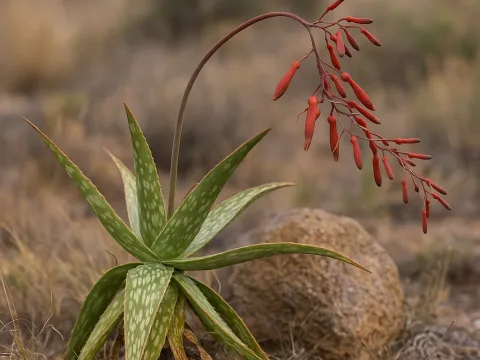
Bitter aloe
Aloe inamara
Bitter aloe (Aloe ferox) belongs to the Asphodelaceae family and is a robust succulent species widely cultivated for its medicinal properties.
What the section contains
Bitter aloe
The propagation of the crop is primarily achieved through seeds, although vegetative propagation using offsets is also a common practice in nurseries.
Seeds should be sown in a well-draining, sandy-based medium during the warm season, as they require temperatures around 20-25 degrees Celsius to germinate.
Surface sowing is recommended, followed by a light covering of grit to maintain optimal humidity levels without risking seed rot.
When using offsets, the parent plant should be healthy and mature, allowing the offsets to develop sufficient roots before separation and replanting.
Aloe ferox originates from South Africa and thrives in environments with high levels of direct solar radiation and excellent air circulation.
The soil must be extremely well-draining, ideally a mix of coarse sand, loam, and gravel to prevent any moisture buildup around the root collar.
This species is highly drought-tolerant and requires minimal water, specifically avoiding deep watering during the dormant winter months.
Temperature fluctuations are generally tolerated, but the plant must be protected from prolonged freezing temperatures which can damage the leaves.
A neutral to slightly acidic soil profile is preferred, reflecting the plant's natural habitat in rocky, well-aerated slopes.
The yield of Aloe ferox is measured by the production of two main components: the bitter exudate (aloe-latex) and the internal leaf gel.
Harvesting usually begins when plants reach a harvestable size, typically 3 to 5 years after establishing the plantation, depending on the environmental conditions.
Proper spacing and management allow for a continuous harvest, as the plant remains productive for many years under professional agricultural care.
The yield per hectare is influenced by the density of the planting and the frequency of leaf harvesting, which must be calibrated to ensure plant health.
Standard agricultural practices focus on optimizing leaf size and thickness to maximize the volume of gel extracted per individual leaf.
The primary threat to Bitter aloe plantations is root rot, which is almost exclusively caused by poor soil drainage and waterlogging.
Pests such as mealybugs and scale insects are common issues that need to be managed through regular monitoring and appropriate biological controls.
Fungal leaf spots can occur if the humidity remains too high for extended periods, necessitating the removal of infected plant tissue.
Root-knot nematodes can also be a significant problem in sandy soils if proper crop rotation and soil preparation are neglected.
- Ensure constant soil drainage.
- Monitor for mealybug infestations regularly.
- Provide sufficient ventilation in the field.
- Remove any decaying leaves promptly.
- Use appropriate biocontrols for insects.
Harvesting Bitter aloe involves cutting the outer leaves near the base of the plant using a clean, sharp knife to avoid damaging the crown.
The leaves are then placed in a slanted position to allow the bitter yellow sap to drain into collection containers for further industrial processing.
Once the sap has drained, the outer skin is removed, and the clear inner fillet or gel is processed for use in health products and medicine.
The timing of the harvest is crucial, with most growers operating during the dry season to minimize the risk of contamination and rot.
Post-harvest stabilization is essential, as the active ingredients in the gel can lose efficacy if exposed to high heat or oxidation for too long.