
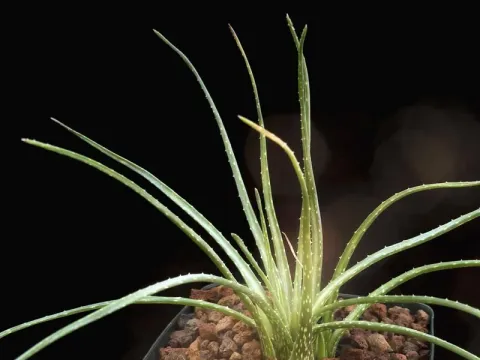
Bowie's Aloe
Aloe bowiea
Bowie's Aloe (Aloe bowiea) is a rare succulent belonging to the Asphodelaceae family. Native to the Eastern Cape of South Africa, it is known for its peculiar growth habit where the plant body is largely subterranean.
What the section contains
Bowie's Aloe
The plant features slender, grass-like leaves that emerge from a bulb-like base buried in the soil. This unique morphology is a direct adaptation to the arid, rocky environments of its natural range, protecting it from intense grazing and heat.
Cultivation requires extreme attention to drainage. A porous, gritty soil mix is mandatory to ensure that the roots do not remain damp, as this species is highly susceptible to rot under humid conditions.
Light requirements are very high, as the plant needs full sun to maintain its specific aesthetic appearance and healthy growth rate. Without sufficient sunlight, the leaves lose their structure and the plant becomes prone to etiolation.
Temperature management is critical for the success of this crop. During the summer, it thrives in warm, dry conditions, whereas in winter, it requires a significant temperature drop and dry substrate to enter dormancy effectively.
The most severe threat to Aloe bowiea is root rot caused by improper watering techniques or heavy, organic-rich soil that holds water for too long.
Mealybugs are the primary pest concern, often hiding deep within the tight leaf clusters, making them difficult to detect and eradicate manually.
Spider mites can also become problematic if the plant is kept in an environment with very low humidity and poor air circulation for an extended duration.
Fungal infections can occur if the plant is misted or if water is allowed to pool in the center of the leaf rosette, leading to rapid tissue death.
Effective pest management involves the use of systemic insecticides specifically labeled for succulent plants, ensuring total coverage of the subterranean and exposed parts.