
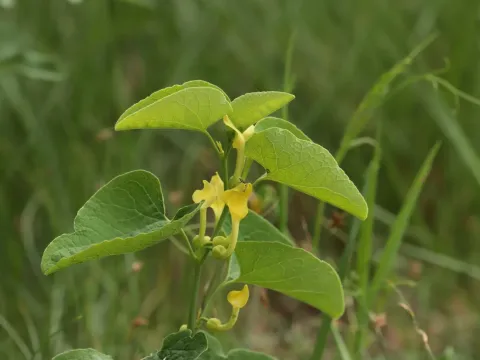
Birthwort
Aristolochia clematitis
Birthwort (Aristolochia clematitis) is typically propagated via seeds sown in late autumn or early spring, provided the seeds undergo a period of cold stratification.
What the section contains
Birthwort
For industrial cultivation, rhizome division is often preferred as it ensures more uniform crop development and faster establishment of the plantation.
When sowing seeds, a depth of about 2 centimeters is optimal, ensuring the soil remains consistently moist until germination occurs.
Spacing between plants should be adjusted based on soil fertility to ensure each plant has enough room to develop its characteristic climbing habit.
The plantation site must be prepared by thorough tilling to eliminate perennial weeds, which are difficult to control once the birthwort is established.
As a member of the Aristolochiaceae family, Birthwort thrives in nutrient-rich, moist, and loamy soils with a neutral pH level.
The plant requires a sheltered location with partial shade, as it is naturally adapted to forest edges and thickets rather than open, sun-scorched fields.
Adequate soil moisture is critical; however, the soil must be well-drained to prevent root asphyxiation during periods of heavy rainfall.
Regular maintenance includes weeding and seasonal application of compost or balanced organic fertilizers to stimulate vigorous growth of the foliage.
It is important to provide support structures if the planting density is high, although Aristolochia clematitis often grows as an erect herbaceous plant.
The plant contains Aristolochic acid, which naturally repels many common agricultural pests, making it relatively low-maintenance in terms of chemical intervention.
However, environmental stress caused by poor soil drainage can lead to root rot, which is the most significant threat to the plant's health.
Fungal infections such as powdery mildew can occur during periods of high humidity and stagnant air, requiring improved ventilation within the canopy.
Monitoring for sucking insects is advised, although they rarely cause damage exceeding the economic threshold in healthy, well-nourished fields.
Maintaining a balanced ecosystem around the field helps to keep pest populations naturally in check, avoiding the need for synthetic pesticides.
The harvesting of birthwort for medicinal use is centered on the aerial parts of the plant, which are collected during the peak of its flowering stage.
Mechanical harvesting must be conducted carefully, ensuring that the stalks are cut at least 10–15 centimeters above the ground to preserve the rhizomes.
Post-harvest handling requires immediate transfer to a shaded, dry area to prevent rapid degradation of the chemical components in the green mass.
Drying is best accomplished in controlled-environment drying facilities, maintaining temperatures below 45 degrees Celsius to preserve efficacy.
Once dried, the plant material should be stored in breathable containers and protected from direct sunlight to maintain its medicinal quality over time.