
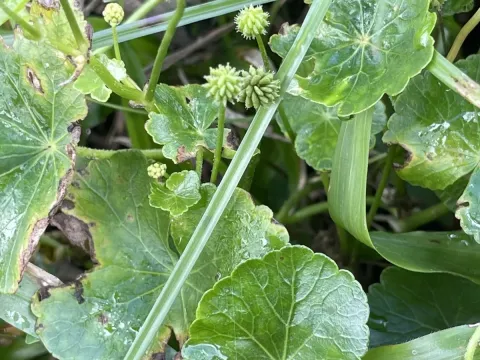
Hydrocotyle ramiflora
Hydrocotyle ramiflora
Propagation of Hydrocotyle ramiflora is primarily achieved through vegetative methods, including the division of rhizomes or stem cuttings. The optimal planting time is during the spring and summer when water and air temperatures remain consistently above 18 degrees Celsius.
What the section contains
Hydrocotyle ramiflora
If sowing by seeds, it is necessary to use a well-moistened substrate consisting of peat and sand. Seeds require high humidity and diffused light for successful germination, a process that can take several weeks.
Planting in open ground or water bodies should only occur after the risk of frost has completely passed. It is crucial to ensure that the plant nodes are in direct contact with a moist substrate to facilitate rapid rooting.
Planting density depends on the specific goals; for establishing a dense carpet, it is recommended to space plants 10 to 15 centimeters apart.
Applying diluted mineral fertilizers immediately after planting can significantly speed up the adaptation process and promote vigorous root growth.
Hydrocotyle ramiflora belongs to the Araliaceae family. It is a perennial herbaceous plant that naturally inhabits humid, marshy areas, stream banks, and shallow waters in tropical and subtropical regions.
The plant has high light requirements; bright, indirect light is essential for the healthy development of stems and leaves. In conditions of insufficient lighting, the stems become elongated, and the leaves lose their vibrant color.
The soil substrate must be consistently moist with a slightly acidic or neutral pH. Ideally, the soil should be silty and rich in organic matter, capable of retaining moisture without stagnation, which could lead to root rot.
The ideal temperature range for cultivation is between 20 and 26 degrees Celsius. Sudden temperature fluctuations and cold drafts are detrimental to the plant's vegetative mass.
When grown indoors, the plant requires high air humidity, which can be maintained through regular misting or by placing it near an open water source.
The yield of Hydrocotyle ramiflora is directly dependent on photosynthetic intensity and the availability of essential nutrients. Under optimal conditions, the plant is capable of forming dense vegetative cover very quickly.
In aquaculture, productivity is determined by the growth rate of the shoots. With adequate mineral nutrition and carbon dioxide control, the plant can cover a water surface within a single growing season.
Economic usage includes its application in landscape design as a decorative element, as well as in the pharmaceutical industry for the production of herbal extracts.
Harvesting is performed by trimming the aerial shoots, which encourages further branching and increases total biomass for the next growth cycle.
Growing efficiency is significantly improved in hydroponic systems, where nutrient levels are strictly controlled, ensuring a stable and high-quality yield of the crop.
The primary threats to this culture are fungal infections, which develop due to poor temperature control or excessive humidity combined with inadequate air circulation.
Pests such as aphids and spider mites are known to infest the plant. Upon detection, it is necessary to perform sanitation using soft insecticides that are safe for aquatic environments.
Improper watering or the use of hard water can lead to chlorosis and leaf yellowing, which weakens the plant and makes it more susceptible to various pathogens.
In greenhouse settings, rhizome rot is a significant danger caused by water stagnation; prevention involves maintaining a drainage layer and disinfecting tools regularly.
It is important to maintain water quality in ponds; competition from unwanted algae can suppress the growth of Hydrocotyle ramiflora by limiting access to light and nutrients.