
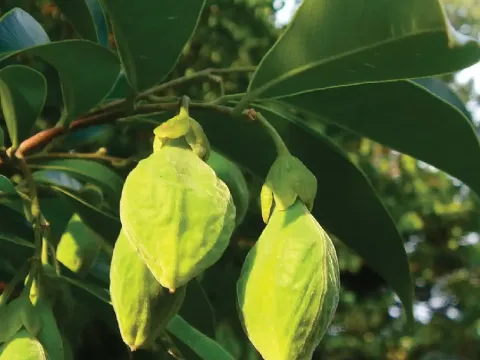
Aquilaria crassna
Aquilaria crassna
Aquilaria crassna is a prized tropical tree species belonging to the Thymelaeaceae family. It is native to the dense tropical forests of Southeast Asia, thriving in regions with high humidity, abundant rainfall, and consistently warm temperatures throughout the year.
What the section contains
Aquilaria crassna
Successful cultivation requires a stable climate with temperatures ranging from 20 to 35 degrees Celsius. The trees perform best in deep, fertile, and well-drained soils rich in organic matter, and they are particularly sensitive to waterlogging, which can cause rapid root decay.
Young saplings require careful management and partial shading to survive their initial growth stages. Exposure to direct, intense sunlight can scorch the leaves and stunt growth, so growers often intercrop with larger species or use artificial shading nets until the trees establish a mature canopy.
Soil moisture management is critical. While the tree requires plenty of water, it does not tolerate stagnant conditions. Implementing a drip irrigation system is highly recommended in commercial plantations to maintain consistent soil moisture levels, especially during shorter dry seasons.
Planting density should be carefully planned to ensure proper airflow between trees. A spacing of 3 to 4 meters is generally recommended to reduce the risk of humidity-related fungal infections and to allow sufficient space for root development and crown expansion.
The main challenge in managing Aquilaria crassna plantations is the control of fungal pathogens. While certain fungi are intentionally introduced to trigger the production of agarwood resin, uncontrolled spread of fungal decay can lead to the premature death of the tree.
Insect pests, particularly stem borers and leaf-eating caterpillars, pose a significant risk to young plantations. If left unmanaged, these pests can severely weaken the tree's structure and health, making it more susceptible to opportunistic pathogens.
Root rot remains a major threat in poorly drained soils. To mitigate this, growers should ensure that planting sites are well-prepared with adequate drainage or established on slightly elevated terrain to prevent water from pooling around the base of the stem.
Viruses and bacterial infections, though less common, can manifest as stunted growth or leaf discoloration. Strict sanitation practices, such as disinfecting pruning tools between each tree, are essential to prevent the spread of diseases across the plantation.
Integrated pest management (IPM) strategies, which prioritize biological controls and habitat management, are preferred over broad-spectrum chemical pesticides to ensure the long-term sustainability and quality of the produced agarwood.
Harvesting Aquilaria crassna is a unique agricultural task because the target product, the agarwood resin, is a stress response rather than a primary botanical component. Producers must stimulate the trees after they reach a sufficient age, typically between 7 and 12 years.
Inoculation techniques, which involve introducing specific fungal strains or physical wounding, are used to trigger the tree's natural defense mechanism. Over several years, the tree accumulates dark, resinous, and highly aromatic compounds in the heartwood at the site of the injury.
The harvest involves selective logging or harvesting the specifically treated parts of the trunk. Skilled laborers carefully extract the resinous wood, as the value of the final product depends heavily on the concentration and purity of the resin within the wood fibers.
Post-harvest processing involves cleaning, grading, and sorting the wood based on its quality. The highest grade of wood is typically sold directly for burning or carving, while lower-quality pieces are processed into essential oil (oud) through steam distillation.
The global demand for high-quality agarwood ensures that a well-managed plantation remains highly profitable. By standardizing the inoculation and harvesting processes, growers can consistently produce a high-yield output that meets international market standards.