
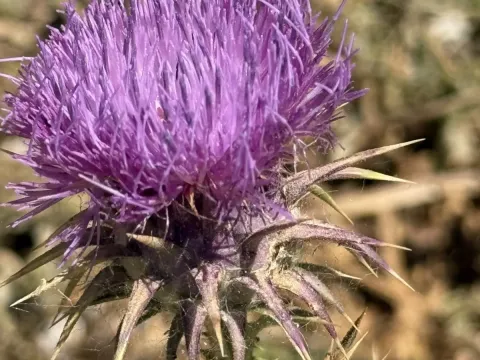
Argolic cotton thistle
Onopordum argolicum
Argolic cotton thistle (Onopordum argolicum) is a biennial plant belonging to the Asteraceae family, often recognized for its robust growth and significant ecological value as a honey plant.
What the section contains
Argolic cotton thistle
For optimal results, seeds should be sown in late autumn or early spring, ensuring that the soil is sufficiently loosened to allow for deep root penetration during the first year.
Row spacing is critical for this crop, and maintaining at least 70 centimeters between rows ensures that each plant receives adequate light and air circulation, reducing the risk of fungal diseases.
Seeds should be planted at a shallow depth of approximately 1.5 to 2 centimeters, as they require light to germinate effectively and lack the energy to push through thick layers of soil.
Following sowing, light soil compaction is recommended to establish good seed-to-soil contact, which is vital for uniform emergence in variable spring weather conditions.
This species is highly adapted to Mediterranean-type climates, thriving in full sun exposure and dry conditions that would be detrimental to many other agricultural crops.
The ideal soil for Onopordum argolicum is well-drained, slightly alkaline to neutral, and sandy-loam in texture, which prevents root rot and supports vigorous structural growth.
Water requirements are relatively low once the plant is established, as its deep taproot allows it to access subsoil moisture during peak summer droughts.
Fertilization is rarely necessary in rich soils, but in nutrient-depleted areas, a moderate application of phosphorus and potassium can significantly boost flower head production.
Temperature range tolerance is wide, as the plant is evolved to withstand scorching summer heat and moderate frosts during its dormant winter rosette stage.
The primary economic output of the Argolic cotton thistle is its high nectar production, making it a preferred plant for apiaries focused on high-quality late-season honey.
Seed yield can be substantial, and the plants are often harvested for their viable seeds, which are sought after in ornamental landscaping and herbal medicine production.
In terms of forage, while the mature plant is thorny, young growth can be processed into nutritious silage, provided that the physical structure of the plant is properly macerated.
The biomass production of this species is notable, particularly in the second year, when the plant reaches its full height and produces numerous large flower heads.
Harvesting for medicinal purposes is usually timed to coincide with the early flowering stage, when the concentration of essential active compounds is at its maximum.
The most significant pests affecting this crop include various species of weevils and aphids that primarily feed on the developing buds and succulent tissues of the stem.
Fungal issues, such as powdery mildew, may occur during high-humidity periods, especially if planting density is too high and airflow is restricted around the leaves.
Effective management involves consistent crop monitoring and the use of targeted biological controls to prevent pest outbreaks without harming beneficial pollinators.
Weed management is mainly crucial during the establishment phase, as the young rosettes can be outcompeted by aggressive grasses if the field is not kept clean.
Avoiding waterlogged conditions is the best preventive measure against root-based pathogens, which are the primary biological threat to the health of the taproot system.
Harvesting for seeds involves cutting the flower heads once they have dried on the stem and turned brown, which usually happens in the late summer months.
Specialized harvesting equipment is often used to manage the spiny nature of the plant, ensuring that the seeds are collected while minimizing contact with the sharp bracts.
After collection, the material must be dried further in a controlled environment to ensure that moisture content remains low, preventing mold during long-term storage.
Cleaning and winnowing are essential processes to separate the seeds from the chaff, allowing for the easy packaging and distribution of the cleaned seed lots.
Remaining plant residues can be incorporated into the soil as organic matter, helping to improve soil structure and recycle nutrients back into the field.