
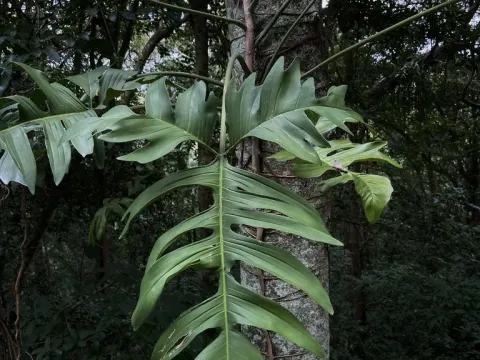
Philodendron
Philodendron Schott corr. Schott
Philodendron is a diverse genus of flowering plants in the Araceae family, native to the tropical regions of the Americas. These plants exhibit a wide range of growth habits, from climbing vines to robust shrubs, often acting as hemiepiphytes in their natural habitat.
What the section contains
 Arrow-leaf Philodendron
Philodendron sagittifolium Liebm.
Arrow-leaf Philodendron
Philodendron sagittifolium Liebm.
 Philodendron domesticum
 G. S. Bunting
Philodendron domesticum
Philodendron domesticum G. S. Bunting
 Philodendron hederaceum
 (Jacq.) Schott
Philodendron hederaceum
Philodendron hederaceum (Jacq.) Schott
 Philodendron tatei
 K. Krause
Philodendron tatei
Philodendron tatei K. Krause
 Philodendron tatei melanochlorum
Philodendron tatei K. Krause spp melanochlorum Bunting Bunting
Philodendron tuxtlanum
Philodendron tuxtlanum G. S. Bunting
Philodendron tatei melanochlorum
Philodendron tatei K. Krause spp melanochlorum Bunting Bunting
Philodendron tuxtlanum
Philodendron tuxtlanum G. S. Bunting
 Philodendron verrucosum
 L. Mathieu ex Schott
Philodendron verrucosum
Philodendron verrucosum L. Mathieu ex Schott
 Philodendron wendlandii
 Schott
Philodendron wendlandii
Philodendron wendlandii Schott
 Red-leaf philodendron
Philodendron erubescens K. Koch & Augustin
Red-leaf philodendron
Philodendron erubescens K. Koch & Augustin
 Split-leaf philodendron
Philodendron bipinnatifidum Schott ex Endl.
Split-leaf philodendron
Philodendron bipinnatifidum Schott ex Endl.
Philodendron
For professional cultivation, Philodendrons require bright, indirect light. Excessive sunlight exposure leads to chlorosis and leaf scorch, while low light conditions significantly reduce photosynthesis rates and result in spindly growth patterns.
The substrate must be well-draining, mimicking the forest floor environment. Professional growers typically utilize a mix containing peat moss, perlite, and pine bark to provide necessary aeration and prevent root asphyxiation during irrigation cycles.
Temperature management is critical for consistent biomass production. The ideal range is between +20°C and +28°C. Plants undergo physiological stress if temperatures drop below +16°C for extended periods, leading to stunted development.
High humidity levels are essential for healthy leaf expansion. In controlled environment agriculture, automated misting or humidification systems are employed to maintain relative humidity between 60% and 80%, promoting optimal physiological activity.
Spider mites are the most persistent pest in Philodendron production. They thrive in low-humidity environments, damaging the leaf epidermis and causing stippling patterns that render the plant unsalable due to aesthetic losses.
Mealybugs are significant threats that colonize leaf axils and stem nodes. Their feeding leads to honeydew secretion, which serves as a medium for sooty mold growth, further compromising the plant's health and marketability.
Root rot caused by Pythium or Phytophthora species remains the primary pathological concern. It is triggered by poor drainage and excessive moisture in the root zone, often occurring when water management protocols are not strictly followed.
Leaf spot diseases, often bacterial in nature, can cause necrotic lesions across the foliage. Control strategies involve maintaining dry leaf surfaces and ensuring adequate airflow within the growth facility to discourage pathogen proliferation.
Integrated Pest Management (IPM) is highly recommended for Philodendron crops, combining biological controls with targeted chemical applications to maintain high phytosanitary standards throughout the production cycle.