
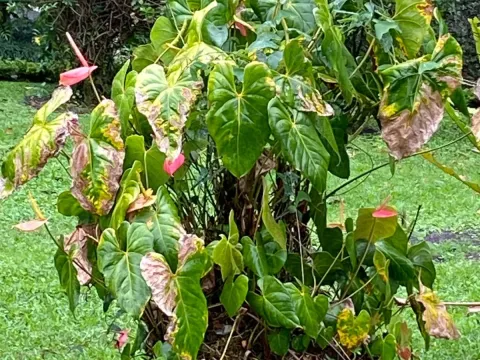
Anthurium
Anthurium Schott
Anthurium (Anthurium Schott) is a diverse genus of evergreen perennials within the Araceae family. It serves as a significant commercial crop globally, primarily cultivated for its aesthetic appeal, longevity as cut flowers, and its utility as a popular ornamental houseplant.
What the section contains
 Anthurium affine
 Schott
Anthurium affine
Anthurium affine Schott
 Anthurium andraeanum
 Linden ex André
Anthurium andraeanum
Anthurium andraeanum Linden ex André
 Anthurium bakeri
 Hook. f.
Anthurium bakeri
Anthurium bakeri Hook. f.
 Anthurium crassinervium
 (Jacq.) Schott
Anthurium crassinervium
Anthurium crassinervium (Jacq.) Schott
 Anthurium crystallinum
 Linden & André
Anthurium crystallinum
Anthurium crystallinum Linden & André
 Anthurium magnificum
 Linden
Anthurium magnificum
Anthurium magnificum Linden
 Anthurium obtusum
 (Engl.) Grayum
Anthurium obtusum
Anthurium obtusum (Engl.) Grayum
 Anthurium polyschistum
 R. E. Schult. & Idrobo
Anthurium polyschistum
Anthurium polyschistum R. E. Schult. & Idrobo
 Anthurium scherzerianum
Anthurium x scherzerianum hort. non Schott
Anthurium scherzerianum
Anthurium x scherzerianum hort. non Schott
 Flamingo Lily
Anthurium-Andreanum-Hybriden
Flamingo Lily
Anthurium-Andreanum-Hybriden
Anthurium
Originating from the tropical regions of Central and South America, the plant naturally thrives in humid environments. Most commercial varieties are hybrids selected for their durability, specific spadix color, and glossy, heart-shaped spathes that characterize the genus.
Successful large-scale production requires a strictly controlled greenhouse climate. The ideal temperature range is 20–28 °C; temperatures falling below 15 °C significantly inhibit growth and nutrient uptake, while exceeding 30 °C requires increased irrigation and ventilation.
The crop requires a highly porous, well-draining substrate to prevent root asphyxiation. Common professional growing media include mixes of peat moss, pine bark, perlite, and charcoal, maintaining a slightly acidic pH between 5.5 and 6.0 for optimal micronutrient availability.
Light management is crucial for high-quality production. Anthurium requires bright, indirect light; therefore, industrial greenhouses often utilize shading systems during peak solar intensity to prevent leaf scorching and to maintain the vibrant coloration of the flower spathes.
In modern horticultural facilities, Anthurium yield is optimized through precision fertigation and controlled-environment agriculture. A healthy, mature plant can produce an average of 18–25 high-quality cut flowers annually when managed under ideal greenhouse conditions.
The main pests affecting the crop include thrips, spider mites, and aphids, which can cause significant damage to the foliage and affect the photosynthetic capacity of the plants. Integrated Pest Management (IPM) is essential for maintaining crop health and minimizing pesticide use.
Pathogenic threats such as bacterial blight (Xanthomonas campestris) and root rots (Pythium and Rhizoctonia) are the primary concerns for growers. These are best managed through rigorous sanitation protocols, proper irrigation control, and preventive fungicide/bactericide application.
Harvesting should occur when the spadix is fully developed, typically indicated by the maturation of the tiny, individual flowers along its length. Flowers are harvested by cutting the stalk at the base, ensuring that the remaining plant tissues are not damaged to facilitate future growth.