
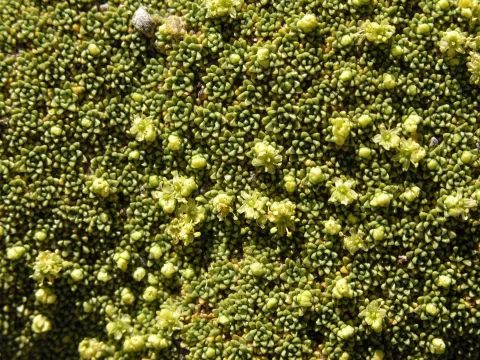
Azorella compacta
Azorella compacta
Azorella compacta, commonly known as yareta, is a perennial evergreen shrub belonging to the Araliaceae family. It is endemic to the high-altitude regions of the Andes, thriving in the harsh environments of Peru, Bolivia, Chile, and Argentina at elevations between 3,000 and 4,500 meters.
What the section contains
Azorella compacta
The plant is biologically defined by its extremely slow growth rate and unique cushion-like morphology. These dense, compact mats are composed of thousands of tightly packed branches, which act as a thermal buffer against the freezing temperatures and high winds typical of the Andean altiplano.
Environmental requirements for this species include high solar irradiance and very low precipitation. The plant is perfectly adapted to the thin, oxygen-poor air of the high Andes, utilizing its low-profile structure to maintain a microclimate within its own dense foliage that is significantly warmer than the ambient surroundings.
Soil requirements are strictly limited to well-drained, nutrient-poor rocky substrates. Azorella compacta cannot survive in waterlogged or nutrient-rich soils, as its root system is specialized for anchoring and extracting minimal moisture from deep within the rocky cracks and fissures of the terrain.
Regarding its utility, the plant has historically served as a fuel source for indigenous populations due to its dense, resinous, and slow-burning nature. However, because it grows only about 1.5 centimeters per year, it is currently protected, as commercial exploitation is ecologically unsustainable.
The primary threats to Azorella compacta are habitat destruction and slow recovery rates. Because the plant is essentially a slow-growing ecosystem in itself, any mechanical damage to the cushion can take decades or even centuries to heal completely.
While the plant faces few traditional agricultural pests in its native habitat, it is susceptible to root rot and physiological stress if exposed to improper moisture levels or non-native substrate conditions during experimental conservation or horticultural propagation efforts.