
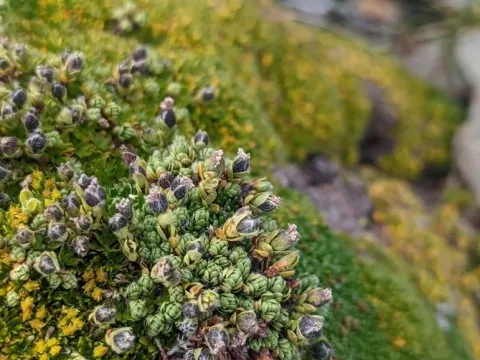
Azorella selago
Azorella selago
Azorella selago is a perennial cushion-forming plant within the Apiaceae family. It is a highly specialized species that has evolved to thrive in the harsh, wind-swept environments of the subantarctic islands in the Indian Ocean.
What the section contains
Azorella selago
Originating from regions like the Kerguelen and Prince Edward Islands, this plant is well-adapted to maritime climates. It prefers nutrient-poor, rocky, or sandy soils where competition from other plant species is minimal, allowing it to dominate the landscape.
The climate requirements for Azorella selago are very specific. It thrives in cool, moist, and windy conditions. The compact cushion structure is an essential physiological adaptation that serves to trap heat, reduce water loss, and protect the plant from physical abrasion by wind-blown debris.
Botanical characteristics include evergreen foliage and a remarkably slow growth rate. The plant creates a dense mat of stems and leaves that can expand over time, slowly modifying the local microclimate and providing a substrate for mosses and lichens.
Regarding its utility, while not cultivated for commercial agricultural production, it is vital for soil stabilization and environmental monitoring. Scientists often use the growth patterns of Azorella to study climate variations in the Southern Ocean over time.
The primary threats to Azorella selago populations include the impact of invasive mammals, particularly rabbits, which consume the plant and destroy the structural integrity of the cushions, leading to significant degradation of habitats.
Climate change poses a long-term danger to the survival of the species. As temperatures rise in subantarctic regions, the species may struggle to compete with more aggressive plant species that were previously restricted by the colder climate.
Pathogenic threats are currently minimal in pristine environments, but increased humidity and temperature variability can create conditions suitable for fungal rot within the dense internal structures of the cushions if not properly ventilated.
Mechanical disturbance from human activity or invasive species leads to slow recovery times. Because the annual biomass increase is minimal, once a cushion is damaged, it can take years or even decades to return to its original form.
Conservation strategies focus on eradicating invasive predators and protecting the native ecosystems. Long-term monitoring is essential to ensure that Azorella selago remains a resilient part of the subantarctic biodiversity.