
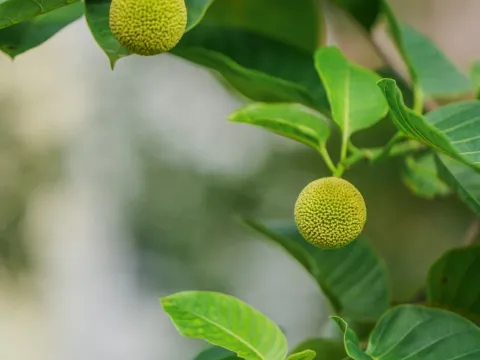
Anthocephalus
Anthocephalus
Anthocephalus (lat. Anthocephalus cadamba), also known as the Kadam tree, is a member of the Rubiaceae family. The seeds of this crop are sown in specialized nurseries into a prepared substrate immediately after harvesting, as they have a limited period of viability.
What the section contains
Anthocephalus
For successful germination, it is necessary to maintain high humidity and a temperature range of 25–30 degrees Celsius. The start of the rainy season is considered the optimal time for establishing a nursery, providing seedlings with sufficient natural moisture for early growth.
Sowing is carried out in containers or beds with loose, well-drained soil rich in organic matter. Once seedlings reach a height of 20–30 centimeters, they undergo a hardening process before being transplanted to their final growing location.
In large-scale cultivation, it is crucial to follow a planting pattern that ensures proper density. A recommended distance of at least 3–4 meters between saplings is advised to ensure adequate light exposure and reduce competition for nutrients.
Transplanting into the open field is performed at the beginning of the rainy season, allowing the root system to adapt before the onset of the dry period. Young plants require regular monitoring during the first two years of development.
This crop has specific environmental requirements, preferring humid tropical climate zones. Anthocephalus performs best at average annual temperatures between 20 and 35 degrees Celsius with high precipitation levels.
Soil preferences include deep, well-aerated loams or alluvial soils with a neutral to slightly acidic pH. The crop is sensitive to waterlogging, despite its preference for high atmospheric humidity, so effective drainage is essential.
Light intensity plays a critical role for Anthocephalus at all growth stages. It is a fast-growing, light-demanding species that requires open areas, preventing shading from other trees during its early years.
In regions with a distinct dry season, an artificial irrigation system must be established during the first years of the tree's life. This is a critical factor in agronomy, as moisture deficiency leads to slower growth and decreased survival rates.
Fertilizing the soil in the early stages promotes intense biomass accumulation. Applying nitrogen-phosphorus compounds during the first two years significantly accelerates root system development and the formation of a straight, uniform trunk.
Anthocephalus is considered one of the fastest-growing tree species in the world, which determines its high economic value. With proper agronomic management, the tree can reach commercial trunk dimensions in just 10–15 years.
Yield is measured by the volume of commercial timber obtained per unit of area. The high growth rate allows for crop rotation every 12–15 years, which is significantly faster than most hardwood species.
The timber of Anthocephalus is used in a wide range of industries, including furniture manufacturing, plywood, matches, and paper pulp. Thanks to its uniform structure, the material is consistently in demand on the market.
In addition to timber, the flowers and fruits of the tree are valuable, finding applications in traditional medicine and the perfume industry. This makes the crop promising for integrated use within forestry systems.
Yield stability depends on pest control and timely maintenance thinning. Pruning plantations helps concentrate resources on the most promising individual trees, ensuring maximum output of high-quality wood raw materials.
The main threats to Anthocephalus are fungal diseases that develop under conditions of excessive humidity and poor air circulation. Stem rot infestation can lead to a loss of the commercial value of the timber.
Pests, such as leaf-eating insects and stem borers, can cause significant damage to plantations. Timely monitoring of tree health allows for the minimization of loss risks at early stages.
A comprehensive approach including both chemical protection and biological methods is used for pest management in industrial forests. It is important to maintain ecosystem health by attracting natural entomophages to control insect populations.
Improper agronomic techniques, including overcrowded planting, contribute to the spread of infections. Disease prevention involves maintaining optimal spacing between trees and regularly clearing the site of fallen leaves and decaying debris.
Young saplings are particularly vulnerable to rodents and certain types of mites. The use of protective nets or fencing during the first years of cultivation is a mandatory maintenance element to preserve the integrity of the young orchard.
Harvesting of Anthocephalus is carried out once the trees reach an optimal trunk diameter, typically at the age of 12–15 years. During this period, the wood possesses the best characteristics for industrial processing.
The harvesting process should be planned to minimize damage to neighboring trees if selective logging is intended. However, clear-cutting methods are more frequently applied in blocks to allow for reforestation.
Freshly cut timber requires rapid transport and processing, as it is prone to staining and rotting when exposed to environmental factors. It is essential to ensure proper storage conditions for the raw material at processing facilities.
After harvesting, the site is cleared and prepared for a new growing cycle. Remaining stumps can be removed or used for root sprout regeneration, depending on the chosen reforestation strategy.
Efficient harvesting also includes the collection of fruits, which are picked manually at the stage of full maturity. This requires additional labor and strict adherence to harvest schedules to preserve the quality of the harvested botanical material.