
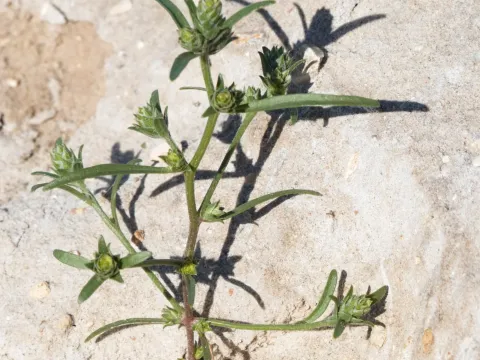
Marshall's Bugseed
Corispermum marschallii
Marshall's Bugseed belongs to the psammophyte group, which are plants specifically adapted to growth in sandy soils. In natural settings, seed dispersal occurs via self-seeding after the fruits mature in late summer or early autumn.
What the section contains
Marshall's Bugseed
When cultivated for agricultural purposes, seeds are sown in early spring as soon as the soil reaches temperatures of 5–8 degrees Celsius. The optimal seeding depth is 1–2 centimeters, as small seeds require firm contact with the moist substrate to germinate successfully.
The culture exhibits high germination energy, allowing it to establish itself quickly on shifting sands. It is essential to maintain adequate soil moisture for the first two weeks post-emergence to facilitate the development of a robust root system.
For forage production, a row-seeding method with intervals of 15 to 30 centimeters is recommended. This setup ensures optimal stand density, allowing each plant to reach its full vegetative potential.
In arid regions, planting can be scheduled for autumn, allowing seeds to undergo natural stratification and germinate with the first spring rains.
This annual herbaceous plant belongs to the Amaranthaceae family and is native to arid zones, steppes, and semi-deserts. It is a signature representative of the flora found in Eurasian sandy landscapes.
The crop has minimal requirements regarding soil fertility and thrives in saline conditions with low organic matter content. However, it is highly sensitive to waterlogging and poor drainage, preferring sandy or loamy-sand substrates.
Marshall's Bugseed is noted for its high drought and heat tolerance, making it a promising candidate for the reclamation of degraded lands. It plays an active role in stabilizing shifting dunes and preventing wind erosion.
For normal development, the plant requires intense sunlight throughout the entire growing season. Shading typically results in a sharp decrease in vegetative biomass and significantly slowed growth rates.
The optimal temperature range for active growth is 20–30 degrees Celsius. The plant is capable of withstanding the significant diurnal temperature fluctuations typical of desert climates.
The biomass yield of Marshall's Bugseed is directly dependent on the amount of precipitation during the spring and summer. On unfertilized sandy soils, it can produce between 3 and 6 tons of dry matter per hectare.
The plant is valued for its protein and mineral content, making it a viable forage component for livestock, especially in arid areas. The nutritional value is at its peak during the flowering phase.
The seed yield is high; a single plant can produce thousands of seeds, ensuring rapid population recovery. Harvesting of seeds is performed mechanically once they have reached full physiological maturity.
Agricultural use includes grazing for camels, sheep, and goats, which readily consume the plant in its early growth stages.
Recent research explores the potential for industrial use, such as extracting plant fibers or utilizing the biomass as a source for bioenergy in extreme climatic conditions.
Marshall's Bugseed is known for its high resistance to common agricultural diseases typical of cereal or forage grasses. The plant contains natural phytoncides that provide protection against various pathogens.
The primary threats to young seedlings include soil-dwelling pests such as scarab beetle larvae or wireworms, although their concentration in clean sandy soils is usually quite low.
High humidity during fruit formation can lead to infections like powdery mildew or rust fungi. Preventive measures involve maintaining proper crop spacing and planting density.
Pests that specialize in the Amaranthaceae family may cause damage to the foliage if the plantings are located near natural habitats of these insects.
For weed management in bugseed crops, mechanical methods such as harrowing are preferred, as chemical treatments may not be cost-effective given the extensive nature of the cultivation.
Harvesting green biomass for livestock feed should be conducted before the stems become overly fibrous, typically at the end of the budding phase or the beginning of flowering. This ensures the best balance of fiber and proteins.
When harvesting for seed production, the process begins when the majority of plants show yellowing, and the seeds have become hard and developed their characteristic coloration.
Using combine harvesters requires adjustments to the cutting mechanism to account for the plant's height and potential lodging. Direct combining is the most common harvest method.
Post-harvest processing involves cleaning the seeds of impurities and drying them in natural conditions. Seeds should be stored in a cool, dry place to maintain high germination rates over several years.
Post-harvest plant residues can be left on the field for mulching, which helps protect the soil from wind erosion and improves moisture retention.