
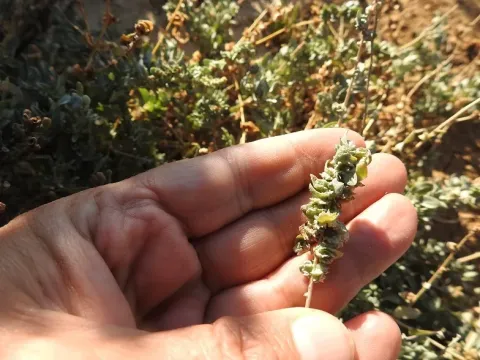
Mauritanian saltbush
Atriplex mauritanica
Mauritanian saltbush is an annual herb belonging to the Amaranthaceae family. Sowing is typically performed in spring once soil temperatures consistently exceed 10 degrees Celsius for optimal germination.
What the section contains
Mauritanian saltbush
The seeds should be sown at a shallow depth of approximately 1 to 2 centimeters. Proper soil contact is essential for uniform emergence, especially in drier environments.
Row planting with spacing of 30 to 45 centimeters is recommended to facilitate maintenance and mechanical weeding during the early stages of the crop's development.
In cases where biomass production is the primary goal, higher seeding rates are used to achieve a dense canopy that suppresses weed competition effectively.
After seeding, light rolling is beneficial to improve soil-to-seed contact and preserve moisture, which is critical for successful crop establishment in arid climates.
This species is highly valued for its extreme tolerance to saline soils, making it an excellent candidate for land reclamation where standard crops fail to thrive.
Mauritanian saltbush requires high levels of solar radiation to maximize photosynthetic activity, necessitating placement in open, unshaded areas for best results.
The plant demonstrates remarkable adaptability to various soil textures, including light sandy soils and heavier clay soils, provided drainage is adequate.
Temperature is a key driver for growth, with the plant showing optimal physiological activity in the 20 to 30 degrees Celsius range, typical for Mediterranean climates.
Minimal moisture is required once the plant is established, as its physiological traits are well-adapted to surviving periods of significant drought throughout the season.
The biomass yield of Mauritanian saltbush is highly responsive to soil fertility and management practices, with optimal outcomes achieved through regular nutrient application.
As a forage crop, it provides a valuable source of nutrients for livestock, particularly in arid or semi-arid regions where conventional grasses struggle for survival.
Nitrogen fertilization during the early vegetative phase can significantly boost growth rates, resulting in higher final yields of succulent green biomass.
The crop's reliability is its main advantage, as it maintains production stability even under environmental stressors that would severely limit common forage crops.
By effectively converting marginal lands into productive pastures, this plant plays a strategic role in sustainable agricultural systems and livestock management.
Mauritanian saltbush generally exhibits high resistance to many common agricultural diseases; however, high humidity can occasionally trigger leaf fungal infections.
Insect pests are the primary biotic threat, focusing on young seedlings and tender leaves; proactive monitoring is essential to prevent significant economic damage.
Integrating the crop into a well-planned rotation system helps break pest cycles and reduces the likelihood of local buildup of harmful insects or pathogens.
Weed management in the early stages of growth is crucial for avoiding competition that could retard the development and yield potential of the saltbush crop.
If severe infestations occur, the use of targeted insecticides may be necessary, but this must be done in accordance with safety protocols for forage production.
Harvesting for fodder should ideally occur just before the plants reach full maturity or seed set to ensure the highest protein content and digestibility for livestock.
Modern forage harvesting equipment is suitable for processing the crop, allowing for efficient collection and storage as green chop or silage for future use.
For seed production, harvesting is delayed until full maturity to ensure seed viability, with careful monitoring to prevent excessive losses due to natural shedding.
Efficient logistics are required post-harvest to manage the biomass promptly, preventing quality deterioration due to heat buildup or excessive humidity in storage.
Proper harvest timing is key to balancing the volume of the yield with the nutritional requirements of the livestock intended to consume the harvested material.