
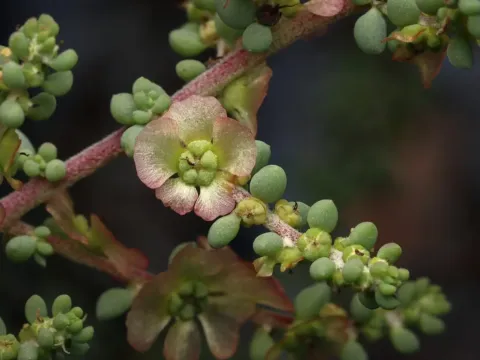
Maireana
Maireana
Sowing of Maireana in its natural range typically occurs after seasonal rainfall, which provides the necessary soil moisture levels for seed germination. In agricultural practice, planting is carried out in late winter or early spring to allow young plants to establish their root systems before the onset of extreme summer heat.
What the section contains


Maireana
The seeds of this culture possess high germination capacity under minimal moisture, yet they require adequate substrate warming. Seed placement depth must be minimal, as the small seeds lack significant energy reserves and cannot penetrate through dense soil layers.
When cultivating on saline sites, it is crucial to sow based on moisture distribution within the soil profile. Optimal results are achieved by sowing into moistened horizons, which is facilitated by using specialized drills designed for dryland zones.
Direct seeding into prepared furrows is a common practice, as it concentrates moisture in the zone of primary root development. This is a critical factor for ensuring seedling survival during the first weeks of the growing season.
An important aspect is the maintenance of spatial isolation when planting different species or varieties if the goal is to preserve the purity of the genetic material. Maireana adapts well to sparse stands, which reduces competition between plants for limited resources.
Maireana belongs to the Amaranthaceae family and is a shrubby halophyte, perfectly adapted to life in semi-arid and desert environments of Australia. The plant is characterized by high tolerance to soil salinity and water scarcity.
For normal development, the crop requires open, sunny locations with good drainage. It grows successfully in sandy, loamy, and sandy-loam soils where other agricultural crops would perish due to high salt concentrations.
Climatic requirements include high average daily temperatures during the growing season and the ability to withstand long periods without atmospheric precipitation. The culture features a powerful root system that allows it to extract moisture from deep soil layers.
The pH of the growing medium is of particular importance and should ideally be neutral or slightly alkaline for most Maireana species. Excessive soil moisture is detrimental to the root system, so areas prone to waterlogging must be avoided.
The plant demonstrates a remarkable ability to survive under high levels of solar radiation due to the presence of protective hairs or succulent leaves that reduce transpiration.
The economic use of Maireana is primarily directed towards establishing fodder reserves in areas unsuitable for traditional crop farming. The plant's biomass is valued for its protein and mineral content, which are essential for grazing sheep and cattle.
Green matter yield directly depends on rainfall quantity and the level of soil salinity where the crop is grown. In favorable years, the crop can provide significant biomass, securing a reserve of feed for farmers during dry periods.
In extensive farming systems, Maireana is used as a pasture crop, where productivity is measured by its ability to recover after being grazed by livestock. Properly managed grazing prolongs the lifespan of the shrubs and stimulates the regrowth of lateral shoots.
Sometimes the biomass is harvested as hay or silage, although due to the high salt content in the plant tissues, it must be introduced into the animal diet gradually. Nutritional value is maintained even when dried, making the plant a strategic forage reserve.
Beyond its fodder value, certain Maireana species are used for the reclamation of degraded lands affected by secondary salinization. In such cases, yield is measured as biomass production per unit area to prevent soil erosion.
The main threats to Maireana are specific desert-dwelling insect pests, such as grasshoppers and various species of weevils, which can destroy young shoots. Damage to vegetative organs reduces the plant's ability to accumulate nutrients.
Fungal diseases are extremely rare due to the extremely dry growing conditions. However, during anomalously wet seasons, root rot caused by excess soil moisture is possible, which can lead to the destruction of plantations.
Overgrazing by livestock poses a serious threat, as animals may consume young shoots before the plant can accumulate enough energy reserves for recovery. This leads to the thinning of vegetation and pasture degradation.
Competition from invasive weed species can suppress the growth of Maireana during its early stages. It is recommended to carry out agronomic measures for weed control during the first two years of the crop's life.
Seed-destroying pests can significantly reduce germination rates during natural regeneration. This necessitates quality control of the planting material and periodic seed treatment before storage.