
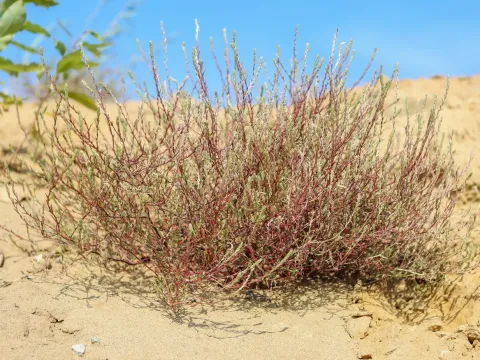
Corispermum declinatum
Corispermum declinatum
Corispermum declinatum, a member of the Amaranthaceae family, is a resilient plant often found in sandy landscapes and disturbed soils.
What the section contains
Corispermum declinatum
Sowing should be performed in early spring as soon as the soil reaches a temperature of approximately 8–10 degrees Celsius to ensure robust germination.
The seeds are small and should be planted at a shallow depth of no more than 1–2 centimeters to allow them to emerge efficiently without using too much energy.
Uniform spacing during seeding is crucial for optimal development and to reduce intra-species competition for light and nutrients.
Given its short growing season, the plant can be effectively used as a secondary crop following the harvest of main winter cereals in warm regions.
This crop thrives in poor, sandy, and sandy-loam soils where other common crops might struggle due to lack of nutrients or poor water retention.
It displays remarkable drought resistance, making it an excellent candidate for cultivation in arid, steppe, or semi-desert climatic conditions.
The plant requires full exposure to sunlight and does not tolerate shaded areas, which can significantly stunt its growth and reduce seed production.
While tolerant to salinity, the plant produces the highest biomass yields when grown in soils with a neutral or slightly alkaline pH level.
Nitrogen availability at the early vegetative stage is the most critical factor for accelerating the development of the foliage and branching structure.
The total yield of Corispermum declinatum is largely determined by the density of the planting and the availability of nitrogenous nutrients.
As a seed-bearing crop, its potential is high, although the harvesting process must be carefully managed to prevent excessive seed loss before collection.
Forage production efficiency is maximized if the plants are harvested before the stems become overly lignified and tough for livestock consumption.
Effective agricultural management and appropriate fertilization can significantly increase the total harvest compared to wild-growing populations.
Research into the yield stability of this plant across different climatic zones remains an ongoing area of agricultural interest for dryland farming.
Due to its hardy nature, the plant exhibits significant natural resistance to most common diseases that affect standard cereal or legume crops.
Insect pests are generally not a major concern; however, vigilance against soil-borne larvae is recommended during the initial establishment phase.
Fungal diseases are rarely encountered unless the crop is grown under conditions of excessive humidity or poor soil drainage, which should be avoided.
Weed control is the primary challenge, particularly during the first few weeks of growth when the seedlings are vulnerable to competitive pressure.
The lack of common specialized pests makes this crop an attractive option for low-input, sustainable, and organic farming systems worldwide.
Harvesting for seeds involves precision monitoring, as the seeds tend to shatter easily once they reach full physiological maturity.
Direct mechanical combining is the standard method, requiring careful adjustment of threshing parameters to avoid damaging the small-sized seeds.
Post-harvest processing requires immediate cleaning to remove chaff and debris, followed by drying to prevent moisture-related storage losses.
Storage facilities must be dry and well-ventilated to preserve the viability of the seeds for future planting seasons or industrial processing.
For fodder purposes, the crop is best harvested during the peak blooming phase to balance protein content and total dry matter yield.