
Creeping saltbush
Atriplex semibaccata
Creeping saltbush, scientifically known as Atriplex semibaccata, is a perennial herb belonging to the Amaranthaceae family. It is widely recognized in agronomy as a highly versatile and resilient plant, capable of thriving in challenging environmental conditions where other forage crops typically fail.
What the section contains
Creeping saltbush
Originating from Australia, this species has evolved to withstand extreme aridity and soil salinity. Due to its remarkable ability to colonize degraded soils, it has been introduced globally, particularly in arid and semi-arid regions, to serve as a cornerstone for rangeland restoration and land stabilization projects.
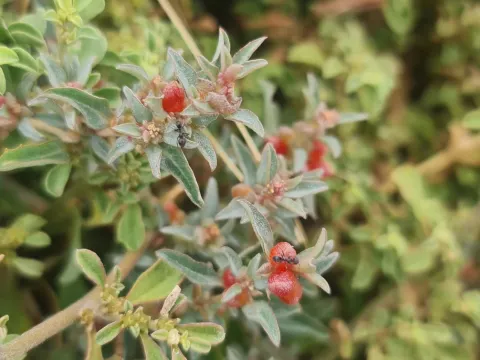
Botanically, the plant is characterized by its prostrate, creeping growth habit, with stems that can spread extensively over the ground. Its leaves are generally small, somewhat fleshy, and often covered with fine silvery hairs, which are an evolutionary adaptation to reflect intense sunlight and reduce transpirational water loss.
The name "semibaccata" refers to the plant's unique fruiting structures, which turn a reddish, berry-like color upon maturity. These succulent fruits are attractive to birds and small mammals, facilitating the natural dispersal of seeds across the landscape, which is essential for colonizing new areas.
In modern agriculture, creeping saltbush is increasingly valued as a forage resource in areas affected by secondary salinization. It provides a reliable source of green fodder during periods when conventional pasture grasses enter dormancy or die off due to high mineral concentrations in the soil.
The primary advantage of creeping saltbush is its exceptional tolerance to soil salinity, often thriving in saline-sodic soils that are considered unsuitable for conventional crops. This makes it a primary candidate for the bioremediation and biological reclamation of abandoned or saline-affected agricultural lands.
The plant requires full sun exposure to maintain vigorous growth. It is highly intolerant of shade and must be sown in open, unobstructed areas. Providing sufficient space between plants during the establishment phase ensures that they can develop their characteristic ground-covering habit without competition.
Soil requirements are relatively low; the species can grow in a wide range of textures, including sands, silts, and light clays. However, it requires well-drained conditions, as prolonged waterlogging can severely damage the root system and lead to plant decline, regardless of the soil salinity levels.
Climatically, creeping saltbush prefers warm, dry environments. While it can withstand occasional light frosts, optimal biomass production occurs during warm growing seasons. It is remarkably heat-tolerant, maintaining high physiological activity even during prolonged drought cycles that would wither most other vegetation.
Agronomic management is minimal once the stand is established. The focus should be on the initial stages of growth to protect seedlings from weed competition. Once the creeping saltbush forms a dense mat, it naturally suppresses most invasive weeds, reducing the need for mechanical or chemical interventions.
The forage yield of creeping saltbush is highly dependent on environmental conditions, but it remains consistent even on poor-quality soils. In productive systems, it can yield several tons of dry matter per hectare, providing essential bulk feed for sheep, goats, and cattle in saline environments.
It is best managed as a continuous grazing crop. The plant exhibits a strong ability to regrow after moderate grazing pressure, making it a sustainable choice for rotational grazing systems. This resilience allows for multiple grazing cycles within a single year under favorable moisture conditions.
The nutritional profile of the plant includes significant levels of protein and essential minerals. However, because the plant absorbs salts from the soil, it should be offered as part of a mixed diet. Providing access to clean water is essential to help livestock process the high salt content in the forage.
Yield optimization can be achieved through strategic management of the harvest cycle. By allowing the plants to recover after grazing, the stand density is maintained, preventing the development of bare patches that could lead to soil erosion or weed encroachment.
While nitrogen fertilizers can boost vegetative growth, they are often unnecessary in saline environments where the plant's primary limitation is salinity rather than nutrient deficiency. The focus should remain on maintaining soil health and water availability to sustain long-term productivity.
While generally hardy, creeping saltbush can be susceptible to defoliating insects during the growing season. However, due to the high salt and secondary metabolite content in the foliage, insect attacks are usually localized and rarely result in the total destruction of the plant population.
Fungal diseases, including leaf spots, may occur in high-humidity or poorly ventilated areas. Preventive measures involve ensuring optimal plant spacing to promote airflow, as the plant is evolved to thrive in dry conditions where fungal pathogen pressure is inherently low.
Weed competition is a concern only during the seedling emergence stage. If weeds are not controlled during the first few weeks, they can easily overtop the slow-growing saltbush seedlings, leading to reduced establishment rates and poor stand uniformity.
Rodents may occasionally feed on the roots or crown of the plant, especially in winter. While localized damage can occur, the species' vigorous root system usually allows for quick recovery, provided the damage is not widespread across the plantation.
Compaction of the soil caused by heavy machinery or overgrazing can lead to oxygen deprivation in the root zone. This is a subtle but significant threat that weakens the plant's natural resistance to environmental stress, potentially leading to increased vulnerability to secondary infections.
Forage harvesting should occur before the plant reaches full maturity or enters the seed-drop phase. Harvesting during the peak vegetative stage ensures that the animal receives the highest protein-to-fiber ratio, supporting optimal livestock weight gain.
If harvested for hay, the forage must be thoroughly dried before storage. Due to the high water content of the fleshy leaves and berry-like fruits, the drying process requires more time than traditional hay-making. Mechanical tedding is highly recommended to improve airflow through the windrows.
Seed harvesting should be carefully timed to coincide with the onset of fruit color change. As the fruits are easily shed, using specialized harvesting equipment or manual collection before peak shedding is necessary to preserve the yield of high-quality seeds for future propagation.
The incorporation of post-harvest residues back into the soil is beneficial for long-term land fertility. The root system contributes significant organic matter to the soil profile, improving its porosity and water-holding capacity, which further aids in the gradual reclamation of the site.
Sustainable harvest management is key to the longevity of a saltbush stand. By avoiding over-harvesting during the plant's dormant or stress periods, the resilience of the system is preserved, ensuring continued productivity for many years on otherwise marginal land.