
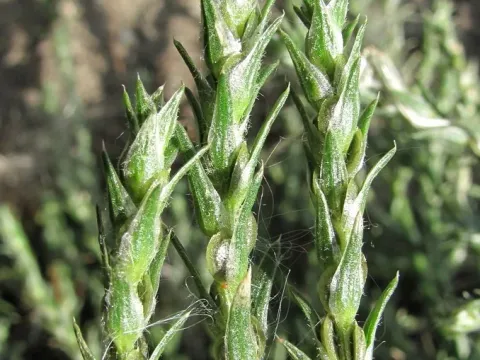
Cold bugseed
Corispermum algidum
Cold bugseed belongs to the Amaranthaceae family and is adapted to regions with extreme climatic conditions. Seed germination typically begins as the topsoil warms up in the spring, marking the start of the vegetative season for this hardy species.
What the section contains
Cold bugseed
The optimal sowing time in natural or semi-cultivated environments occurs shortly after snowmelt, when soil moisture is sufficient to support initial growth. The seeds exhibit high germination energy, allowing the crop to establish itself quickly in sandy soils.
Seeds should be sown at a minimal depth, as the small size of the grain makes it sensitive to soil compaction. Ensuring good seed-to-soil contact is essential for obtaining uniform seedling emergence at the beginning of the season.
The crop shows high adaptability to rapid temperature fluctuations typical of early spring. This allows cold bugseed to be sown earlier than many other forage crops, ensuring early biomass accumulation.
Adjusting the seeding density depends on the intended use, whether for seed production or forage. When grown for forage, row sowing is practiced to optimize the yield of above-ground biomass throughout the summer.
This plant is known for its exceptional endurance against harsh environmental factors. It is perfectly adapted for growth in sandy, light loamy, and saline soils where other conventional agricultural crops struggle to survive.
Good soil aeration is critical for the root system of cold bugseed. It is highly drought-tolerant, exhibiting xerophytic characteristics, which makes it a promising candidate for reclaiming degraded lands and preventing wind erosion.
The plant thrives under intense sunlight. Prolonged exposure to direct rays stimulates photosynthesis and the accumulation of nutrients in the stems and leaves, even during extended dry spells.
Regarding soil chemistry, cold bugseed shows high tolerance to salinity, allowing it to be cultivated on salt marshes. The application of mineral fertilizers, particularly nitrogen, can significantly boost green mass production.
The crop does not tolerate waterlogging or marshy conditions. Optimal vegetation requires well-drained areas where excessive moisture that could lead to fungal infections is avoided.
The yield of cold bugseed is heavily dependent on the level of precipitation during the critical phases of plant development. In arid farming, it consistently provides reliable dry matter output, which is valuable for maintaining forage supplies.
Maximum productivity is achieved by using optimal seeding rates and keeping fields free from heavy weed pressure. Timely soil management practices contribute to more intensive bush development and biomass yield.
During the flowering phase, the plant accumulates a significant volume of nutrients. This is the most suitable period to assess potential yield, as the green mass reaches its peak nutritional value at this stage.
When used as a phytomeliorative crop, cold bugseed forms a powerful root system that effectively stabilizes sandy soils. While this does not always translate into harvest weight, it is a key metric for its agricultural value.
The seed productivity of the species is quite high, allowing the crop to easily reseed itself naturally. This reduces the need for annual sowing and simplifies the maintenance of the agrocenosis.
The main threats to cold bugseed are fungal diseases that develop during periods of high humidity. Root rot can occur if there is excessive precipitation early in the summer season.
Pests typical of the Amaranthaceae family, such as certain weevils or aphids, may damage young shoots. However, due to the rigidity of the stems, the crop suffers significantly less damage than juicier forage grasses.
Weeds pose a competitive threat only during the earliest stages of vegetation. Once cold bugseed gains strength, it becomes the dominant species, successfully suppressing most weeds within the field.
Drought, despite its high resistance, can slow growth if accompanied by extremely high temperatures during seed formation, negatively affecting the quality of the next year's seed material.
Preventive measures include crop rotation and avoiding overly dense plantings. Proper spacing ensures sufficient air circulation between plants, preventing the accumulation of moisture at the base of the stems.
Harvesting for forage is performed before the seeds fully mature, while the plant remains succulent. Mowing is carried out using traditional machinery, ensuring an appropriate cutting height to preserve the root system.
For seed harvesting, the crop should be gathered after the majority of the vegetative mass has turned yellow. Cold bugseed seeds are prone to shattering, so the harvest window must be tight to minimize losses.
After mowing, the biomass must be dried in a timely manner. Due to its stem structure, cold bugseed loses moisture quickly, allowing for prompt storage or processing into forage meal.
Using modern combine harvesters allows for single-stage harvesting once the seeds reach wax ripeness. Cleaning the seeds requires specialized sieves due to their small size and specific shape.
Storing the harvested crop does not require complex conditions. The primary requirement is a low-humidity environment in storage facilities, which prevents product spoilage and mold growth.