
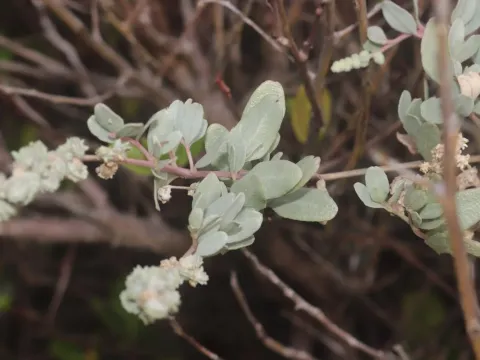
Creeping saltbush
Atriplex repens
Creeping saltbush (Atriplex repens) belongs to the Amaranthaceae family. It is a perennial herbaceous plant recognized for its prostrate growth habit, which allows it to cover the soil surface effectively.
What the section contains
Creeping saltbush
This species is highly valued as a halophyte, an organism that thrives in high-salinity environments. Its ability to tolerate salt concentrations that are toxic to most crops makes it a key candidate for the rehabilitation of saline agricultural lands.
The plant demonstrates remarkable drought resistance, making it an ideal choice for arid and semi-arid climates. It survives in environments with scarce precipitation and intense solar radiation by regulating its internal osmotic pressure.
It prefers well-drained sandy or loamy soils but shows good adaptability to various textures. Its deep and extensive root system contributes to soil stabilization, preventing wind and water erosion in vulnerable landscapes.
Historically and commercially, the plant is studied for its potential as a forage source. It provides essential biomass in regions where traditional forage crops fail, serving as a sustainable alternative for livestock production.
The main pests affecting creeping saltbush include various species of leaf beetles and miners that target the foliage. These insects can reduce the photosynthetic area, which directly impacts the plant's overall growth rate and final yield.
Fungal pathogens such as powdery mildew represent a significant threat during periods of high atmospheric humidity. These diseases appear as white spots on the leaves, severely affecting the quality of the green biomass.
Root rot caused by Oomycetes and other soil-borne fungi is a concern primarily in poorly drained soils. Over-irrigation or stagnant water after rainfall often triggers these complications in sensitive populations.
Aphid colonies can occasionally infest the growing tips of the plants, resulting in stunted development and leaf curling. Regular field scouting is necessary to detect these infestations early in the growing season.
Integrated pest management strategies involve the use of biological control agents and maintaining optimal plant density. Ensuring adequate air circulation between rows significantly reduces the prevalence of both fungal infections and pest outbreaks.