
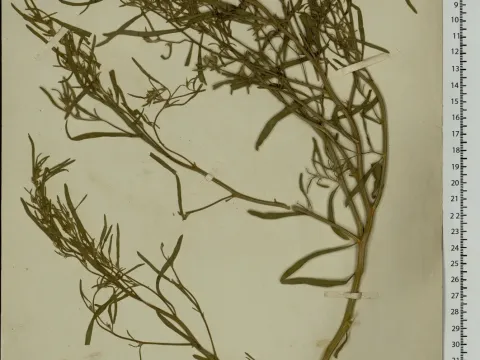
Corispermum canescens
Corispermum canescens
Sowing Corispermum canescens is best performed in early spring when the sand has begun to warm up but still retains sufficient moisture. Proper moisture management during the germination phase is the primary success factor for establishment.
What the section contains
Corispermum canescens
The seeds are relatively small and require shallow placement, typically around 1 centimeter in depth. Drilling the seeds into the sand using grain drills calibrated for fine-seeded crops is the standard procedure.
Row spacing should be kept at 20 to 30 centimeters to allow for adequate soil aeration. This spacing helps the plants develop robust root systems while preventing early-stage competition for limiting soil nutrients.
Winter sowing is also a viable option in specific climate zones, allowing seeds to undergo cold stratification naturally. This often leads to earlier germination and better establishment before the intense summer heat arrives.
Immediately after seeding, mechanical rolling of the field is crucial. This helps lock the seeds into the substrate, preventing them from being scattered by high winds which are common in sandy environments.
As a member of the Amaranthaceae family, this species is a specialist in colonizing sandy habitats. It thrives in soils with low nutrient content where typical agricultural crops would fail to survive or yield any biomass.
The plant is highly heliophilic and requires full sun exposure throughout the day. Shaded conditions lead to weak growth, reduced development of the root system, and ultimately, lower survival rates in the field.
It is remarkably drought-tolerant, possessing physiological adaptations that allow it to endure long periods without rain. It functions as an essential component in desert greening and sand dune stabilization projects.
The crop does not require significant fertilization, as it is adapted to nutrient-poor soils. Excessive nitrogen can lead to succulent growth that makes the plant more susceptible to wind breakage and pest attacks.
Optimal growth occurs at high temperatures, typically between 25 and 35 degrees Celsius. It is also quite tolerant of soil salinity, making it suitable for areas where more conventional crops cannot thrive.
The most significant threat to Corispermum canescens comes from locusts and grasshoppers, which can migrate and devastate large areas of vegetation. Monitoring populations during the peak summer months is recommended.
Root rot is the primary disease risk, usually triggered by waterlogging or poor drainage. Ensuring that the site has sufficient permeability is the best cultural control method to maintain plant health.
Soil-dwelling larvae, such as wireworms, can damage young seedlings. If infestation risk is high, assessing soil condition prior to planting is advisable to avoid excessive loss of stand during the early growth stages.
Fungal diseases like powdery mildew may occur in regions with unseasonably high humidity. However, these are generally minor issues that do not threaten the overall yield or survival of the crop.
Weed competition is only a significant issue during the first few weeks after emergence. Once the plants achieve a closed canopy, they are highly effective at suppressing most competing vegetation.