
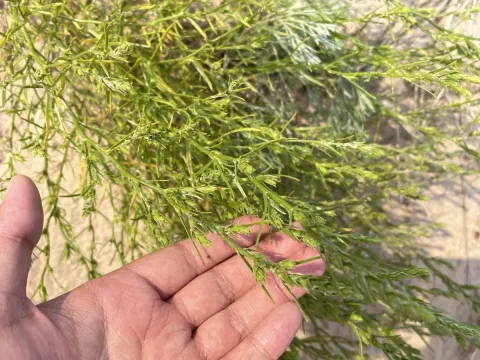
American bugseed
Corispermum americanum
American bugseed, known botanically as Corispermum americanum, is an annual plant species belonging to the Amaranthaceae family. It is distinguished by its remarkable ability to thrive in sandy environments and areas characterized by low soil fertility.
What the section contains
American bugseed
Native to North America, this plant is well-adapted to harsh climatic conditions. It exhibits high levels of drought tolerance and is frequently found in dunes or disturbed sandy soils where other agricultural crops would fail to establish.
The cultivation requirements for Corispermum americanum prioritize well-drained, loose soil types. Exposure to direct sunlight is essential for optimal growth, as the plant is highly photophilous and suffers from competition in shaded environments.
From an agricultural standpoint, it serves as a robust cover crop. Its deep, fibrous root system is instrumental in preventing wind erosion, making it a viable candidate for land reclamation projects in degraded or sandy terrain.
The plant holds potential in low-input agriculture. It requires minimal fertilization and water management compared to traditional fodder crops, though its overall biomass yield is significantly dependent on local rainfall distribution during the early growth stages.
The most common threats to Corispermum americanum are fungal pathogens, particularly root rot, which typically occur in poorly drained soils or during periods of excessive precipitation. Drainage management is crucial to plant health.
Pest pressure from aphids is a recurring issue, as these insects target the tender stems and leaves, leading to reduced vigor and stunted development. In severe infestations, aphids may also act as vectors for various plant viruses.
Weed control is mandatory during the seedling establishment phase. Because the species exhibits a relatively slow initial growth rate, it is easily outcompeted by aggressive weeds, necessitating mechanical weeding to ensure a successful stand.
Soil-borne diseases can accumulate if the plant is grown continuously in the same fields without proper rotation. Integrating non-related crops into the rotation cycle helps in maintaining soil health and disrupting pathogen life cycles.
Insects such as weevils may occasionally damage the reproductive parts, impacting seed production quality. Integrated Pest Management (IPM) practices, emphasizing biological controls, are generally preferred over intensive chemical intervention.