


SKU #73687
·
63 views
BARUSA
Quinoa
User rating
0 votes0% positive reviews
No ratings yet — be the first.
Mass of 1000 seeds (g)
3.0-3.5 g
Registration year
2017
About product

Quinoa «Barusa» is a high-yielding variety of pseudocereals, recognized in the state register for all growing zones. Plants reach a height of about 220 cm, and at maturity, the stem acquires a cream color with a pink base. The panicle has a spindle shape, 50–55 cm long, dense and cream-colored, which provides good protection for seeds from external influences.Seeds are disc-shaped, light beige, 10…
Mass of 1000 seeds (g)
3.0-3.5 g
Registration year
2017
Description
Quinoa «Barusa» is a high-yielding variety of pseudocereals, recognized in the state register for all growing zones. Plants reach a height of about 220 cm, and at maturity, the stem acquires a cream color with a pink base. The panicle has a spindle shape, 50–55 cm long, dense and cream-colored, which provides good protection for seeds from external influences.
Seeds are disc-shaped, light beige, 1000 seeds weigh approximately 3.3 g. The vegetative period lasts 115–120 days; plants are sensitive to frost at early stages and require a sufficient amount of moisture, but after the panicle forms, they become drought-resistant. Yield in the Krasnodar Territory reaches 40.8 c/ha (average) and can reach 60.5 c/ha under optimal conditions.
Quinoa «Barusa» is distinguished by its high nutritional value: contains up to 19% protein with a fully balanced amino acid composition, and is also rich in calcium, potassium, iron, magnesium, and other minerals. The composition includes all nine essential amino acids, making it a valuable source of complete nutrition. Quinoa does not contain gluten, so it is suitable for people with celiac disease or gluten intolerance.
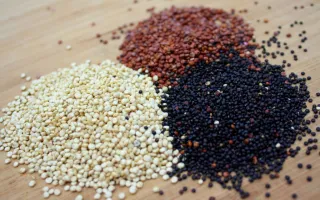
Culinarily, quinoa «Barusa» is easy to prepare: boiled in water, milk, or broth in a ratio of 1 part grain to 2 parts liquid. Cooking time is 11–15 minutes for the white variety; black and red require 4–5 minutes more. The grain can be used as a side dish, added to salads, soups, cutlets, desserts, and also used in baking – cakes, pancakes, or casseroles.
The «Barusa» variety is not susceptible to diseases, but can be damaged by aphids. It was developed by Dmitriev Dmitriy Vladimirovich and Taranenko Sergey Anatolyevich, and its originator is the same Dmitriev. The variety was included in the register of admitted crops in 2017.
Seeds are disc-shaped, light beige, 1000 seeds weigh approximately 3.3 g. The vegetative period lasts 115–120 days; plants are sensitive to frost at early stages and require a sufficient amount of moisture, but after the panicle forms, they become drought-resistant. Yield in the Krasnodar Territory reaches 40.8 c/ha (average) and can reach 60.5 c/ha under optimal conditions.
Quinoa «Barusa» is distinguished by its high nutritional value: contains up to 19% protein with a fully balanced amino acid composition, and is also rich in calcium, potassium, iron, magnesium, and other minerals. The composition includes all nine essential amino acids, making it a valuable source of complete nutrition. Quinoa does not contain gluten, so it is suitable for people with celiac disease or gluten intolerance.
Culinarily, quinoa «Barusa» is easy to prepare: boiled in water, milk, or broth in a ratio of 1 part grain to 2 parts liquid. Cooking time is 11–15 minutes for the white variety; black and red require 4–5 minutes more. The grain can be used as a side dish, added to salads, soups, cutlets, desserts, and also used in baking – cakes, pancakes, or casseroles.
The «Barusa» variety is not susceptible to diseases, but can be damaged by aphids. It was developed by Dmitriev Dmitriy Vladimirovich and Taranenko Sergey Anatolyevich, and its originator is the same Dmitriev. The variety was included in the register of admitted crops in 2017.
Crop & resistance
Crop
Specifications
| Mass of 1000 seeds (g) | 3.0-3.5 g |
|---|---|
| Registration year | 2017 |
| Catalog | Catalog → Quinoa |
| Legal data |
Show · 3
|
| Country | Russia |
Store offers
Prices are updated on loadLoading offers…
Aggregator catalog: prices are collected automatically from store websites, normalized by AI and converted at the current exchange rate. Before ordering, confirm the price and availability on the store's website. This block is not indexed by search engines — the data is loaded after the page opens.
Not yet комментариев. Be the first!

See also
Often considered together with this variety







Recently viewed
Products you’ve viewed on this site
Reviews · 0