


SKU #73686
·
77 views
SEVA
Quinoa
User rating
0 votes0% positive reviews
No ratings yet — be the first.
Mass of 1000 seeds (g)
3.0-3.5 g
Registration year
2017
About product

Quinoa variety "SEVA" is an annual crop characterized by high yield and nutritional value. Plants reach a height of about 220 cm, and the stem acquires a straw-yellow color with a pinkish hue upon ripening. The spear-shaped panicle is 60–65 cm long, has a yellow-orange color, and medium density. The seeds are disc-shaped, beige, with 1000 seeds weighing 3.4–3.5 g.The crop is characterized by a veg…
Mass of 1000 seeds (g)
3.0-3.5 g
Registration year
2017
Description
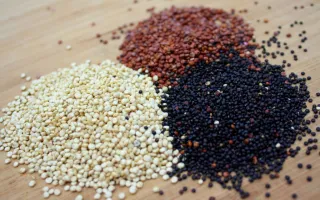
Quinoa variety "SEVA" is an annual crop characterized by high yield and nutritional value. Plants reach a height of about 220 cm, and the stem acquires a straw-yellow color with a pinkish hue upon ripening. The spear-shaped panicle is 60–65 cm long, has a yellow-orange color, and medium density. The seeds are disc-shaped, beige, with 1000 seeds weighing 3.4–3.5 g.
The crop is characterized by a vegetation period of 111–112 days, with flowering and ripening periods extended to up to 30 days each. Plants are sensitive to frost at early growth stages but become drought-resistant after forming the main panicle. Under conditions of the Krasnodar Krai region, the average yield is 41.7 c/ha, and the maximum is 62.2 c/ha.
Quinoa "SEVA" has a high protein content of up to 19% and a balanced amino acid composition. The grain surpasses cereal crops in calcium, potassium, iron, magnesium, and other mineral content, making it a valuable product for dietary nutrition.
The crop grows stably under various climatic conditions: from cold to dry and moderate. It prefers loamy soils with good drainage and a neutral or alkaline medium (pH 4.5–9). Quinoa withstands extreme temperatures (+38 °C and –8 °C) and uses water efficiently due to high drought resistance. With proper care, plants are not susceptible to serious diseases but may suffer from aphid damage.
Variety "SEVA" is a patented crop developed by Dmitriev Dmitry Vladimirovich and Tarantenko Sergey Anatolievich. It is included in the state register for all zones of crop cultivation and is recognized as a reliable choice for both agriculture and high-quality food production.
The crop is characterized by a vegetation period of 111–112 days, with flowering and ripening periods extended to up to 30 days each. Plants are sensitive to frost at early growth stages but become drought-resistant after forming the main panicle. Under conditions of the Krasnodar Krai region, the average yield is 41.7 c/ha, and the maximum is 62.2 c/ha.
Quinoa "SEVA" has a high protein content of up to 19% and a balanced amino acid composition. The grain surpasses cereal crops in calcium, potassium, iron, magnesium, and other mineral content, making it a valuable product for dietary nutrition.
The crop grows stably under various climatic conditions: from cold to dry and moderate. It prefers loamy soils with good drainage and a neutral or alkaline medium (pH 4.5–9). Quinoa withstands extreme temperatures (+38 °C and –8 °C) and uses water efficiently due to high drought resistance. With proper care, plants are not susceptible to serious diseases but may suffer from aphid damage.
Variety "SEVA" is a patented crop developed by Dmitriev Dmitry Vladimirovich and Tarantenko Sergey Anatolievich. It is included in the state register for all zones of crop cultivation and is recognized as a reliable choice for both agriculture and high-quality food production.
Crop & resistance
Crop
Specifications
| Mass of 1000 seeds (g) | 3.0-3.5 g |
|---|---|
| Registration year | 2017 |
| Catalog | Catalog → Quinoa |
| Legal data |
Show · 3
|
| Country | Russia |
Store offers
Prices are updated on loadLoading offers…
Aggregator catalog: prices are collected automatically from store websites, normalized by AI and converted at the current exchange rate. Before ordering, confirm the price and availability on the store's website. This block is not indexed by search engines — the data is loaded after the page opens.
Not yet комментариев. Be the first!

See also
Often considered together with this variety




Recently viewed
Products you’ve viewed on this site
Reviews · 0