


SKU #73688
·
61 views
KADI
Quinoa
User rating
0 votes0% positive reviews
No ratings yet — be the first.
Days to Technical Maturity
110-120 days
Mass of 1000 seeds (g)
3.0-3.5 g
Registration year
2017
About product

Kadi quinoa variety – an annual plant from the amaranth family, grown in various climatic zones thanks to its adaptability and high yield. The vegetation period lasts 117–122 days, and plants reach about 220 cm in height. At maturity, the stem turns a pink-red hue, while the panicle becomes semi-spreading, loose, and dark red, measuring 55–60 cm in length. Seeds are disc-shaped, dark beige in colo…
Days to Technical Maturity
110-120 days
Mass of 1000 seeds (g)
3.0-3.5 g
Registration year
2017
Description
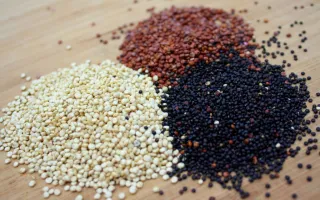
Kadi quinoa variety – an annual plant from the amaranth family, grown in various climatic zones thanks to its adaptability and high yield. The vegetation period lasts 117–122 days, and plants reach about 220 cm in height. At maturity, the stem turns a pink-red hue, while the panicle becomes semi-spreading, loose, and dark red, measuring 55–60 cm in length. Seeds are disc-shaped, dark beige in color, with a mass of 1000 seeds ranging from 3.3 to 3.4 g. Due to these characteristics, Kadi ensures a stable yield: in Krasnodar Krai, the average yield is about 40.8 c/ha, and the maximum exceeds 62 c/ha.
Kadi quinoa is distinguished by its high nutritional content. The grain contains up to 19% protein with a balanced amino acid profile and surpasses most cereal crops in calcium, potassium, iron, magnesium, and other minerals. Additionally, it is gluten-free, making it safe for people with celiac disease or gluten intolerance. Seeds are easily cleaned of bitter saponins during processing and can then be used as grain, flour, or added to dishes.
The Kadi variety shows high drought resistance after panicle formation and is not susceptible to diseases, although it may be damaged by aphids. It is suitable for cultivation in all regions of Russia, including northern, central, Volga, chernozem, Caucasian, Middle Volga, Urals, Siberian, and Far Eastern regions. Due to its versatility and nutritional value, Kadi is a sought-after product for both agriculture and the food industry.
Kadi quinoa is distinguished by its high nutritional content. The grain contains up to 19% protein with a balanced amino acid profile and surpasses most cereal crops in calcium, potassium, iron, magnesium, and other minerals. Additionally, it is gluten-free, making it safe for people with celiac disease or gluten intolerance. Seeds are easily cleaned of bitter saponins during processing and can then be used as grain, flour, or added to dishes.
The Kadi variety shows high drought resistance after panicle formation and is not susceptible to diseases, although it may be damaged by aphids. It is suitable for cultivation in all regions of Russia, including northern, central, Volga, chernozem, Caucasian, Middle Volga, Urals, Siberian, and Far Eastern regions. Due to its versatility and nutritional value, Kadi is a sought-after product for both agriculture and the food industry.
Crop & resistance
Crop
Specifications
| Days to Technical Maturity | 110-120 days |
|---|---|
| Mass of 1000 seeds (g) | 3.0-3.5 g |
| Registration year | 2017 |
| Catalog | Catalog → Quinoa |
| Legal data |
Show · 2
|
| Country | Russia |
Store offers
Prices are updated on loadLoading offers…
Aggregator catalog: prices are collected automatically from store websites, normalized by AI and converted at the current exchange rate. Before ordering, confirm the price and availability on the store's website. This block is not indexed by search engines — the data is loaded after the page opens.
Not yet комментариев. Be the first!

See also
Often considered together with this variety






Recently viewed
Products you’ve viewed on this site
Reviews · 0