
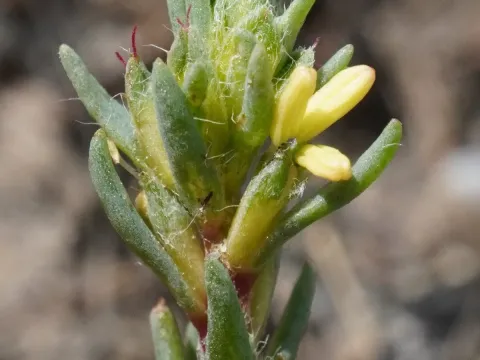
Camphorosma annua
Camphorosma annua
Camphorosma annua is a herbaceous annual belonging to the Amaranthaceae family, highly specialized for growth in saline environments.
What the section contains
Camphorosma annua
The plant serves as a vital biological indicator of saline soils, thriving where other agricultural species are unable to survive.
Sowing should be carried out in early spring when the soil retains sufficient moisture, which is critical for uniform germination of seeds.
Seeds should be planted at a shallow depth of 1–2 cm to ensure proper access to oxygen and light, facilitating a faster emergence of seedlings.
Standard row planting with intervals of 30–45 cm is recommended to allow for easy mechanical maintenance and better aeration of the crop.
The crop strictly requires high soil salinity, making it an ideal candidate for reclaiming or utilizing degraded salt-affected lands.
It demonstrates remarkable drought tolerance and is well-adapted to the high temperatures characteristic of arid and semi-arid climates.
Full sun exposure is essential for the optimal physiological performance of the plant, as it has a high light requirement throughout its cycle.
Alkaline soil pH is preferred, as the species has evolved to process high mineral concentrations effectively within its vascular system.
Adequate drainage is necessary to prevent waterlogging, which the plant does not tolerate, despite its ability to manage saline stress.
The biomass yield of Camphorosma annua varies significantly based on the degree of soil salinity and the seasonal distribution of rainfall.
In favorable conditions, the crop produces a substantial amount of forage that can be utilized effectively in grazing systems for livestock.
The plant possesses a strong regenerative capacity, allowing it to recover quickly after harvesting or grazing, ensuring sustainable biomass supply.
The nutritional quality of the forage remains stable even late in the growing season, which adds significant value to agricultural land use.
Yield stability is primarily determined by the plant density, necessitating accurate sowing rates to maximize the total green mass harvested.
Camphorosma annua is generally resistant to most pests due to the high salt concentration in its tissues, which discourages many herbivores.
Root rot and other fungal diseases may occur if the soil is poorly drained, leading to excessive moisture retention around the root collar.
Weed competition during the seedling stage is the primary threat to stand establishment, as early growth is relatively slow.
Regular monitoring for invasive weed species is required to ensure the crop maintains its dominance in the designated saline environment.
During extreme drought, certain insects may occasionally target the green parts of the plant, though economic damage is usually minimal.
Harvesting for green forage should occur during the full flowering stage to ensure the highest protein and mineral content in the crop.
Seed collection requires precise machinery adjustments, as the seeds are small and prone to shattering if harvesting is delayed.
Post-harvest drying must be performed promptly to preserve the quality of the green mass and prevent decomposition or fermentation.
Mechanical harvesting equipment should be calibrated specifically for small-seeded crops to maintain efficiency and minimize field losses.
Incorporating crop residues into the soil after harvest can help maintain the mineral balance of the land, supporting future growing cycles.