
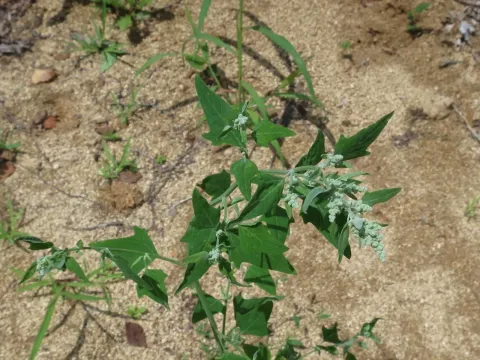
Bryony-leaved goosefoot
Chenopodium bryoniifolium
Bryony-leaved goosefoot is an herbaceous plant belonging to the Amaranthaceae family. In its natural environment, the plant's development typically begins in early spring, once average daily temperatures reach 8–10 degrees Celsius, allowing for robust early growth.
What the section contains
Bryony-leaved goosefoot
For cultivation, seeds are sown in well-moistened, loose soil at a depth of 1–2 centimeters. Optimal sowing times generally fall in late April or early May, providing the plants enough time to establish a strong biomass before the onset of extreme summer heat.
Adequate spacing between rows is essential for this crop, with 30–40 centimeters being the recommended interval to ensure each plant has enough room for development. The plant exhibits high germination energy, leading to uniform emergence under proper moisture levels.
Agronomic management includes thinning the stands early in the season to prevent overcrowding. Dense planting reduces air circulation and access to light, which can significantly hinder the quality of the harvested leaves and increase the risk of disease.
Choosing well-structured, aerated soils with a neutral pH is crucial for successful establishment. The incorporation of organic matter prior to sowing provides a stable nutritional base, which helps the crop thrive during its rapid vegetative development phase.
The crop thrives in sunny locations, as shading can lead to elongated, weak stems and a reduction in the accumulation of secondary metabolites. It requires fertile soil, rich in nutrients, to maintain steady growth throughout the season.
The ideal temperature range for Bryony-leaved goosefoot is 18–24 degrees Celsius. When temperatures consistently exceed this range, the plant may trigger its reproductive phase prematurely, leading to early bolting and a decrease in the quality of the greens.
Good soil drainage is essential to prevent waterlogging, as the roots are sensitive to anaerobic conditions. Loam and sandy-loam soils that are rich in humus represent the best conditions for achieving high-quality yields in a farming environment.
While the plant shows some adaptation to fluctuating moisture, consistent hydration is required for maximum productivity. During dry spells, drip irrigation or light sprinkling is recommended to prevent the leaves from becoming tough and fibrous.
Implementing a proper crop rotation plan is vital to prevent the buildup of soil-borne pathogens common to the Amaranthaceae family. Growing this crop in the same field for consecutive years should be avoided to maintain soil health.
The primary agricultural objective for this crop is the production of high-quality green biomass. Yield performance is heavily dependent on management practices, including timely nitrogen fertilization and effective moisture control throughout the growth cycle.
Under intensive cultivation systems, yields of green mass can reach 15–20 tons per hectare. Maximizing yield requires monitoring the nutrient status of the plants, particularly during the peak of vegetative growth to ensure vigorous leaf production.
Harvest timing is critical, as the highest concentration of nutritional compounds is found in young leaves before the onset of flowering. Delaying the harvest leads to an increase in secondary cell wall deposition, which lowers the culinary value of the crop.
Due to its biochemical profile, this plant is increasingly recognized as a candidate for functional foods and high-protein green fodder. Ongoing research into its potential as a specialty vegetable crop is highlighting its nutritional density.
Reliable yield assessment requires considering local climatic adaptation and specific soil conditions. Selecting improved genotypes can significantly increase the total harvest potential and ensure better consistency in final product quality.
Primary threats to the crop include pests like the beet leaf miner, which damages the leaf tissue and reduces aesthetic and commercial value. Early detection and prophylactic control measures are necessary to protect the plant's photosynthetic capacity.
Fungal diseases, such as downy mildew and rust, pose a threat, particularly in environments with high humidity and poor air circulation. Crop management practices that keep foliage dry and promote airflow are essential for preventing these outbreaks.
Nematodes can become a significant problem in fields with poor crop rotation history. Maintaining healthy soil biodiversity and using certified seeds help mitigate the risk of these soil-dwelling pests interfering with plant health.
Weed competition is most severe during the first month after emergence. Consistent inter-row cultivation is required to ensure that the seedlings are not outcompeted for water and nutrients, which could lead to stunted growth.
Integrated pest management strategies should prioritize non-chemical interventions, such as physical barriers and biological controls, ensuring that pesticide usage is restricted to cases of extreme necessity and following safety regulations.
Harvesting is ideally performed in the early morning to ensure the leaves maintain maximum turgor. This approach helps in preserving the freshness and crispness of the greens during the subsequent handling and transport stages.
The harvest can involve total plant cutting or selective leaf harvesting, depending on the desired market form and the scale of production. Selective harvesting allows for multiple picking events, extending the seasonal availability of the greens.
Post-harvest, the product should be cooled rapidly to decrease its metabolic rate and prolong shelf life. Storing the harvested material at temperatures between 0–2 degrees Celsius with high relative humidity is vital for quality retention.
Transport must be carried out using ventilated packaging to prevent overheating, which can cause rapid spoilage of leaf tissues. Ensuring airflow within crates and shipping containers is essential for maintaining a high-quality product for the end consumer.
After the harvest, crop residues should be managed according to sustainable practices, such as composting or incorporation into the soil, provided the plants are free from severe pathogen contamination to ensure field sanitation for the next season.