
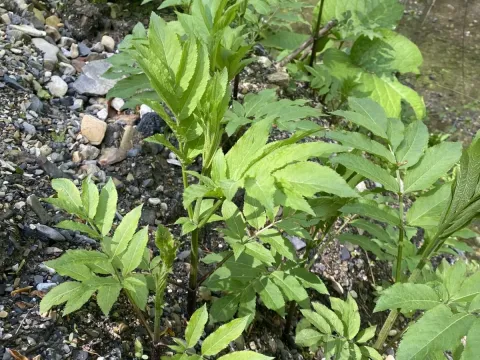
Dwarf elder
Sambucus ebulus
Dwarf elder is a perennial herbaceous plant belonging to the Adoxaceae family. Unlike shrubby varieties, the aerial part of this plant dies back annually in winter and regrows from a powerful rhizome in spring.
What the section contains
Dwarf elder
Propagation is most commonly achieved vegetatively by dividing rhizomes in early spring or late autumn. Seed propagation is possible but requires long stratification of seeds, which makes it less common in standard agrotechnics.
When planting, it is necessary to follow a spacing scheme that allows sufficient room for expansion, as the plant forms dense thickets. The optimal period for establishing a plantation is early spring.
The plant is characterized by aggressive growth, so when cultivating it on industrial or domestic plots, it is important to limit the spread of the root system.
The planting material must be healthy, free from signs of rot, and possess well-developed dormant buds to ensure a high survival rate in a new location.
Dwarf elder prefers moist, fertile soils with good aeration. It thrives on loams and chernozems rich in humus and nitrogenous compounds.
The crop is highly light-loving, although it can tolerate minor shading. In conditions of full shade, the stems stretch out, and the concentration of biologically active substances decreases.
The plant is undemanding regarding climatic conditions, exhibiting high frost resistance due to the deep positioning of its rhizomes in the soil.
An important factor for active growth is the availability of sufficient soil moisture throughout the growing season, especially during the flowering phase.
Agrotechnics include timely cultivation of row spacing and weed control, which is essential until the dwarf elder reaches full development and can outcompete other plants.
The plant has a specific odor that repels many pests, but it can be affected by aphids, especially during the budding period.
Among fungal diseases, the most dangerous are leaf spots that develop during excessive humidity and in overcrowded plantings.
Root rot can become a problem if water stagnates in the soil, requiring the organization of efficient drainage on plots with heavy mechanical composition.
Disease prevention consists of crop rotation and sanitary cleaning to prevent the accumulation of an infectious background in the soil.
The use of biological preparations is the preferred method of protection, as dwarf elder is frequently used in pharmacopeia applications.
The main raw materials for agricultural and medicinal purposes are the fruits, roots, and leaves of the plant, all of which have strictly defined harvest times.
Fruits are harvested in the phase of full maturity when they acquire their characteristic black color, which usually occurs in late August or September.
Rhizomes are harvested in late autumn when the aerial part of the plant has completely died back and the concentration of active components reaches its peak.
After harvesting, the material is subjected to thorough drying in the shade or in specialized dryers at temperatures not exceeding 45 degrees Celsius.
Storage of dried plant material should be carried out in dry, well-ventilated areas using paper packaging or textile bags to maintain quality.