
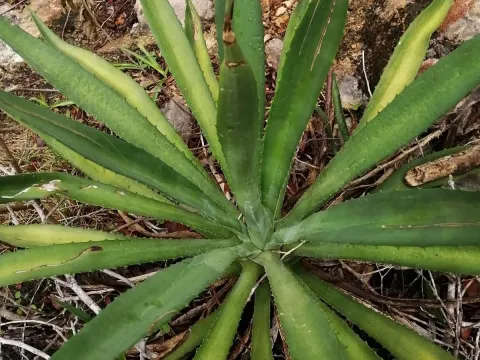
Agave zapupe
Agave zapupe
Planting of Agave zapupe is traditionally initiated at the onset of the rainy season, which provides the young plants with the necessary moisture for root establishment. In commercial plantations, vegetative propagation is practiced using offsets or suckers detached from the parent plant.
What the section contains
Agave zapupe
The optimal planting density involves a spacing of approximately 2.5 to 3 meters between rows, and at least 1 to 1.5 meters between individual plants within the row. This layout ensures adequate space for growth and simplifies maintenance and access to inter-row spaces.
An essential stage is the preparation of planting pits, which must be deep enough to secure the root system firmly. Initial development of the crop is slow; therefore, ensuring the plot is free of weeds during the first two years of the agave's life is critical.
To improve survival rates in poor soils, the application of organic fertilizers within the planting pit is recommended. However, it is important to avoid excess nitrogen, which can lead to excessive growth of soft tissues and reduced strength of the final fiber.
In modern agricultural settings, agronomists recommend regular monitoring of seedlings during the first few months after transplanting. If necessary, temporary irrigation should be organized to prevent desiccation of young rhizomes before the full rainy season begins.
Agave zapupe is a heat-loving crop of the Asparagaceae family, requiring tropical or subtropical conditions for optimal development. The primary cultivation range is historically concentrated in the state of Veracruz, Mexico, where the plant thrives in high humidity.
The crop prefers well-drained, sandy-loam or loamy soils that do not tolerate waterlogging. Excessive root moisture often leads to fungal infections and plantation failure; therefore, choosing a site with natural drainage is a key agronomic factor.
The plant possesses characteristic broad leaves that accumulate significant amounts of fiber. Externally, it resembles other agave species but is distinguished by a specific leaf structure adapted for efficient cellulose synthesis in its native climate.
Sunlight plays a crucial role in accumulating high-quality fiber; therefore, plantations should be established in open, sunny locations. The plant performs poorly in shade, which leads to leaf elongation and a reduction in their mechanical strength.
Drought tolerance is less pronounced in this species compared to its desert-dwelling relatives, meaning Agave zapupe requires a stable annual rainfall. Temperature ranges should remain between 20 and 30 degrees Celsius throughout the vegetative cycle.
The economic value of this crop lies in the production of high-quality, long fiber suitable for manufacturing ropes, twines, and coarse fabrics. Plantation productivity depends directly on planting density and the intensity of leaf management.
Yield is evaluated based on the mass of leaves harvested from each plant per season. A mature specimen can yield several dozen leaves annually, providing stable raw material supplies over 6 to 8 years of active plantation operation.
After 8 to 10 years of growth, the plant typically sends up a flower stalk, marking the end of its life cycle and the accumulation of maximum biomass. During this stage, fiber content in the leaves peaks, making harvesting the most cost-effective.
The fiber extraction process requires specialized decorticating machinery that separates the vegetable fibers from the pulp. The quality of the final product depends heavily on processing efficiency and adherence to drying protocols.
By-products of the process, such as the leaf pulp, can be utilized as organic fertilizer. This allows for a partially circular production cycle, returning essential nutrients back to the soil of the plantation.
The primary threats to Agave zapupe plantations are sucking pests, particularly various species of weevils that attack the core and base of the leaves. Damage by these insects often serves as an entry point for secondary bacterial infections.
Fungal diseases, such as root neck rot, occur primarily when drainage conditions are compromised. Affected plants show stunted growth, yellowing leaves, and loss of firmness, rendering them unsuitable for industrial use.
Disease outbreaks are often facilitated by high planting density and the absence of sanitary pruning of damaged leaves. Regular inspection of rows allows for the early detection of infection hotspots, enabling containment before spread occurs.
Weed infestation in the inter-row spaces acts as a competitor for water and nutrients and can serve as a reservoir for pests. Effective weed control during the early stages of agave development is a mandatory agronomic measure.
The use of chemical protection should be strictly regulated to ensure it does not compromise the quality of the organic fiber. Agronomists recommend prioritizing biological control methods and adhering to phytosanitary standards when selecting planting material.
Harvesting Agave zapupe is performed manually using specialized sharp knives (coa), with which the leaf is cut as close to the base as possible. This process requires skill to avoid damaging the main stem of the plant.
The optimal harvest time is determined visually: the leaf should have reached its full size but not yet begun to show signs of natural wilting. Harvesting is generally conducted on a rolling basis throughout the year as individual leaves reach maturity.
Harvested leaves must be delivered to the processing point within 24 to 48 hours. This prevents fiber spoilage caused by fermentation processes and dehydration of the tissues.
Transporting raw materials from the fields to the decortication plants should be handled carefully to avoid mechanical damage to the fibers. During hot weather, exposure of the harvested material to direct sunlight should be minimized.
After mechanical cleaning, the fiber is washed and dried on dedicated platforms. Proper drying prevents darkening of the material and maintains its natural strength and elasticity, which are vital for the final market value.