
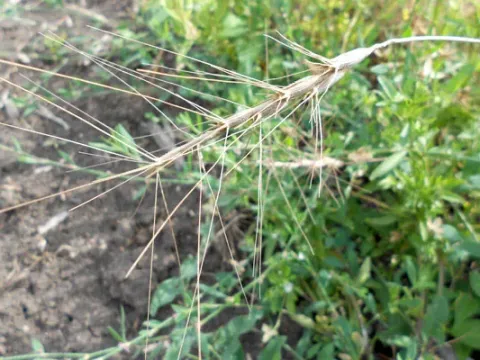
Aegilops tauschii
Aegilops squarrosa
Aegilops tauschii is a diploid wild grass species belonging to the Poaceae family. It is globally recognized in agronomy and botany as the essential donor of the D-genome for modern hexaploid bread wheat (Triticum aestivum).
What the section contains
Aegilops tauschii
The native range of this species extends across the Near East, Caucasus, Central Asia, and parts of China. It typically thrives in arid and semi-arid climates, often colonizing disturbed soils, field margins, and rocky slopes.
The plant demonstrates remarkable environmental plasticity. It prefers well-drained, nutrient-poor, or even saline soils where many commercial crops fail to establish. Its ability to tolerate severe water stress is a subject of ongoing research.
Botanically, it features a slender, cylindrical spike that shatters upon maturity. This adaptation is crucial for the dispersal of its seeds in wild environments. Its growth cycle is usually synchronized with winter or spring rainfall patterns.
In agriculture, the primary utility of Aegilops tauschii is its role as a genetic reservoir. Breeders utilize this species to introgress favorable traits into domestic wheat, including resistance to salinity, heat tolerance, and specific fungal pathogens.
Aegilops tauschii is susceptible to several pathogens that also plague commercial wheat, such as Puccinia species causing rust. These wild populations often serve as a natural source for monitoring rust race evolution.
Powdery mildew can affect the leaves during the tillering and stem elongation stages. While wild specimens have some natural defenses, high humidity and temperature fluctuations can still lead to significant infections in dense populations.
Insects like the wheat stem sawfly and various species of aphids are known pests. They can impact seed production and biomass, although the plant has developed survival mechanisms that allow it to persist under moderate pest pressure.
From a weed management perspective, Aegilops is problematic in wheat-growing areas. Since it is closely related to crops, managing it using herbicides without damaging the main crop is a complex agrotechnical challenge.
The study of these threats is vital for global food security. By understanding the interaction between Aegilops and its natural pests, scientists can develop more resilient varieties of wheat that possess durable, multi-gene resistance.