
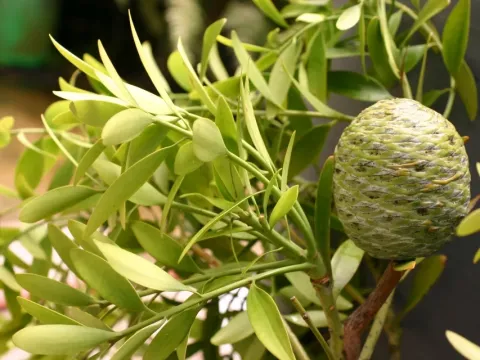
Pacific Kauri
Agathis macrophylla
Pacific Kauri (Agathis macrophylla) is a majestic evergreen conifer belonging to the Araucariaceae family. Native to the tropical rainforests of the South Pacific, including Fiji, Vanuatu, and the Solomon Islands, it is highly valued for its quality timber.
What the section contains
Pacific Kauri
The tree thrives in deep, well-drained, and nutrient-rich soils. Waterlogged conditions are detrimental to its root system, making site selection with adequate drainage a primary prerequisite for successful establishment and long-term growth.
Climate requirements include high annual rainfall and consistently warm tropical temperatures. While the tree can adapt to a range of altitudes, it performs best in sheltered areas protected from strong, drying winds which can damage foliage.
Botanically, Agathis macrophylla is known for its massive, straight trunk and wide-spreading canopy. The leaves are broad and leathery, an adaptation that allows the tree to maximize light interception within the dense tropical forest canopy.
Agronomic management focuses on maintaining a healthy layer of organic mulch around the base of the tree. This helps retain soil moisture and suppresses the growth of competitive vegetation, which is vital for sapling development.
Root rot pathogens represent the most significant threat to Pacific Kauri, especially in nursery settings or areas with poor soil drainage. Implementing strict irrigation schedules is essential to mitigate these risks effectively.
Various stem-boring insects can attack the trees, tunneling into the wood and weakening the structural integrity of the trunks. Integrated pest management strategies are often required to control these populations in large plantations.
Fungal infections can also enter through wounds on the bark caused by poor pruning or mechanical damage. It is crucial to perform all maintenance tasks with specialized equipment to minimize tree injury.
Competition from invasive plant species is a major challenge during the early years of reforestation. Regular weeding and clearing around young saplings are necessary to ensure they receive adequate light and nutrient availability.
Changes in local ecosystems may introduce new pests or diseases, necessitating constant surveillance. Early detection of any unusual symptoms is key to preventing widespread loss in managed timber stands.