
Drakaea
Drakaea
Drakaea is a genus of terrestrial orchids belonging to the Orchidaceae family, native to southwestern Australia. These plants are famous for their remarkable evolutionary adaptation to highly specific environmental niches.
What the section contains

Drakaea
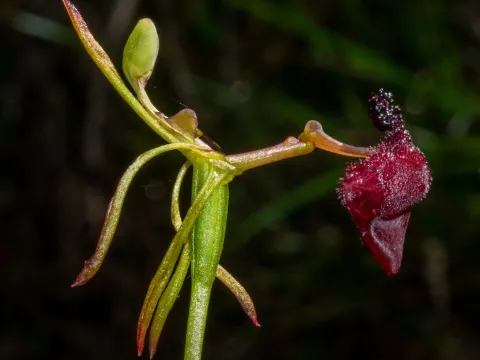
The defining characteristic of the plant is its hammer-like floral structure. This complex morphology acts as a lever to facilitate sexual deception, mimicking female thynnid wasps to attract males for pollination.
Drakaea cultivation is virtually impossible outside of its natural habitat because the plant relies on a symbiotic relationship with specific mycorrhizal fungi to germinate its seeds.
The plant grows a single leaf during the rainy season and enters a state of dormancy during the hot, dry Australian summer. During this period, the above-ground part of the plant completely disappears.
The soil requirements for Drakaea are strictly dictated by the presence of local soil microflora. Standard horticultural substrates do not support the development of this complex botanical species.
The primary threat to the stability of Drakaea populations is habitat fragmentation and the loss of natural vegetation due to urban development and agricultural expansion.
Any disruption in the population of its specific thynnid wasp pollinators leads to reproductive failure, as the orchid cannot be fertilized by any other insect species.
Climate change, which alters the timing and amount of winter rainfall, creates a significant risk to the plant's ability to complete its growth cycle before the onset of summer drought.
Invasive plant species can outcompete Drakaea in its native range, preventing the growth of seedlings and reducing the available area for the orchid to thrive.
Soil-borne pathogens represent a persistent threat when the balance of the ecosystem is disturbed, potentially causing the rot of underground tubers during the dormancy phase.