
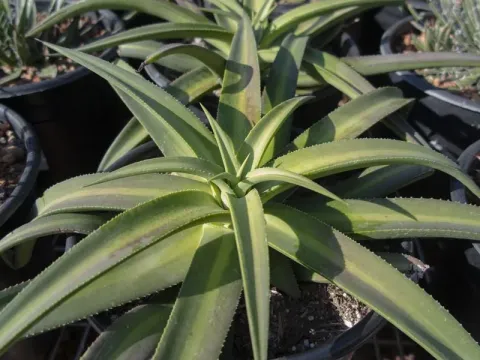
Agave nizandensis
Agave nizandensis
Agave nizandensis propagation is primarily carried out via seeds, which require a specialized, well-draining substrate mix to germinate effectively.
What the section contains
Agave nizandensis
Sowing is best performed during the spring season to capitalize on the increasing photoperiod, which significantly boosts seedling vigor.
Seeds should be sown on the surface of the soil medium, as they require a certain level of light exposure to trigger the germination process.
Maintaining a stable temperature range between 22 and 26 degrees Celsius is essential for achieving optimal germination rates for this species.
Young seedlings must be protected from intense heat and direct sunlight initially, gradually hardening them off as they develop their root systems.
This species is native to the Nizanda region of Oaxaca, Mexico, and thrives in limestone-rich, arid rocky habitats.
Cultivation requires a substrate with excellent aeration and drainage properties, typically consisting of pumice, coarse sand, and perlite.
Exposure to bright, direct light for several hours a day is vital for maintaining the plant's characteristic compact growth habit and foliage coloration.
Watering frequency should be strictly regulated to follow the soak-and-dry method, ensuring the medium is dry before the next hydration cycle.
Agave nizandensis is sensitive to frost and should be kept in environments where temperatures do not drop significantly below 10 degrees Celsius.
Overwatering remains the most critical threat to Agave nizandensis, as stagnant water in the substrate leads to rapid root system decay.
Mealybugs are the most common pests that infest the leaf axils, hiding within the tight foliage to feed on the plant sap.
Fungal pathogens can arise during periods of high humidity and poor ventilation, often manifesting as spots or rot on the leaves.
Regular inspections are necessary to ensure that pests do not establish a foothold, especially in the tight central rosette of the agave.
Integrated pest management, including the use of systemic insecticides and proper airflow, is recommended to keep the plants healthy and robust.