
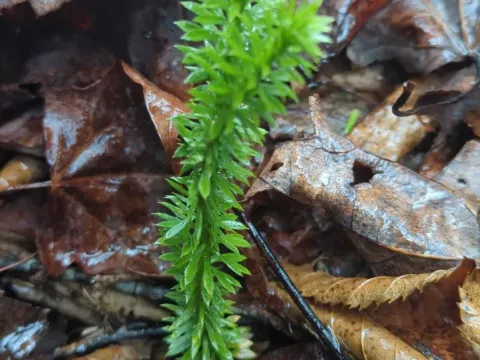
Fir clubmoss
Huperzia
Fir clubmoss (Huperzia selago) is a perennial evergreen spore-bearing plant belonging to the Lycopodiaceae family. It typically forms dense, upright, dichotomously branching stems that reach heights of 5 to 20 centimeters.
What the section contains
 Arctic fir clubmoss
Huperzia arctica
Arctic fir clubmoss
Huperzia arctica
 Fir clubmoss
Huperzia selago
Fir clubmoss
Huperzia selago
 Fir clubmoss
Huperzia serrata
Fir clubmoss
Huperzia serrata
 Huperzia goebelii
Huperzia goebelii
Huperzia goebelii
 Huperzia miyoshiana
Huperzia miyoshiana
Huperzia miyoshiana
 Huperzia nummulariifolia
Huperzia nummulariifolia
Huperzia nummulariifolia
 Huperzia phlegmaria
Huperzia phlegmaria
Huperzia phlegmaria
 Huperzia sieboldii
Huperzia sieboldii
Huperzia sieboldii
 Huperzia squarrosa
Huperzia squarrosa
Huperzia squarrosa
 Huperzia suberecta
Huperzia suberecta
Huperzia suberecta
 Huperzia varia
Huperzia varia
Huperzia varia
 Shining firmoss
Huperzia lucidula
Shining firmoss
Huperzia lucidula
Fir clubmoss
The plant thrives in moist, shaded environments, commonly found in boreal and coniferous forests or alpine tundra. It requires acidic, well-drained but constantly moist soil rich in organic humus to sustain its slow growth cycle.
Cultivation of Huperzia selago is biologically demanding. The life cycle involves a subterranean gametophyte stage that strictly requires a symbiotic relationship with specific soil fungi to germinate and develop into a mature sporophyte.
Climate requirements for this species are centered on cool temperatures and high atmospheric humidity. It cannot tolerate direct exposure to sunlight or drought, which makes artificial propagation in greenhouse settings very labor-intensive.
In economic terms, the plant is primarily harvested for its chemical compounds, such as huperzine A, which is used in pharmaceutical research for treating neurological conditions. Because of its slow growth rate, the plant is often protected and wild harvesting is strictly regulated.
Habitat loss due to deforestation and land development remains the primary threat to Fir clubmoss populations globally. Its reliance on specific forest microclimates makes it highly sensitive to ecosystem changes.
Soil pollution, including nitrogen deposition from agricultural runoff, can negatively affect the fungal symbionts that are vital for the plant's survival, leading to a collapse of the local population.
Diseases affecting Fir clubmoss are usually related to improper drainage and the lack of air circulation, which facilitate the spread of fungal pathogens that attack the root system and stem bases.
While the plant produces alkaloids that discourage most insects and herbivores, its slow regenerative capacity makes it unable to recover quickly from trampling or mechanical damage caused by human or animal traffic.
Climate change poses a long-term threat as shifting temperature gradients move the plant's ideal niche, potentially forcing local extinctions in parts of its traditional range where migration is not possible.