
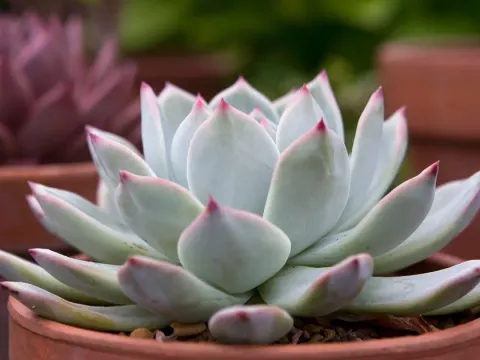
Echeveria
Echeveria DC.
Propagation of Echeveria (Echeveria DC.), a member of the Crassulaceae family, is commonly achieved through vegetative methods or seeds. Sowing is best performed in early spring, as the increasing day length and light intensity support optimal seedling development.
What the section contains
 Hybrid Echeveria lilacina and Echeveria secunda
Hybrids between Echeveria lilacina Kimnach & R. C. Moran and Echeveria secunda Booth ex Lindl.
Hybrid Echeveria lilacina and Echeveria secunda
Hybrids between Echeveria lilacina Kimnach & R. C. Moran and Echeveria secunda Booth ex Lindl.
 Hybrid of Echeveria elegans and Echeveria pulidonis
Hybrids between Echeveria elegans and Echeveria pulidonis
Hybrid of Echeveria elegans and Echeveria pulidonis
Hybrids between Echeveria elegans and Echeveria pulidonis
 Hybrids of Echeveria agavoides and Echeveria lilacina
Hybrids between Echeveria agavoides and Echeveria lilacina
Hybrids of Echeveria agavoides and Echeveria lilacina
Hybrids between Echeveria agavoides and Echeveria lilacina
 Hybrids of Echeveria harmsii, Echeveria setosa and Echeveria affinis
Hybrids between Echeveria harmsii J. F. Macbr., Echeveria setosa Rose & Purpus and Echeveria affinis E. Walther
Hybrids of Echeveria harmsii, Echeveria setosa and Echeveria affinis
Hybrids between Echeveria harmsii J. F. Macbr., Echeveria setosa Rose & Purpus and Echeveria affinis E. Walther
 Hybrids of Echeveria purpusiorum and Echeveria setosa
Hybrids between Echeveria purpusiorum and Echeveria setosa
Hybrids of Echeveria purpusiorum and Echeveria setosa
Hybrids between Echeveria purpusiorum and Echeveria setosa
 Plush Plant
Echeveria pulvinata Rose
Plush Plant
Echeveria pulvinata Rose
 Wax agave
Echeveria agavoides Lem.
Wax agave
Echeveria agavoides Lem.
Echeveria
The seeding medium should consist of a sterile, well-draining mixture such as sand and light loam. Seeds are scattered on the moist surface without covering, and containers are sealed to maintain high humidity during the germination process.
Temperatures should be held between +20°C and +25°C. Regular ventilation is crucial for the seedlings to prevent "damping off" and the growth of mold. Once the first pair of true leaves appears, seedlings must be transplanted into small individual pots to encourage balanced root growth.
Vegetative propagation via leaf cuttings is standard practice. After detaching healthy leaves, they must be air-dried for several days until a callus forms at the base; this step is essential to prevent rot upon planting in the substrate.
Maintaining hygiene during these processes is vital. All tools and containers should be disinfected to prevent the transmission of pathogens that frequently affect succulent nursery stock.
Echeveria is a heliophilic crop requiring high levels of solar radiation throughout the growing season. In indoor conditions, supplementary LED lighting is often necessary to prevent etiolation, where the plant grows leggy and loses its compact, decorative rosette shape.
The ideal substrate must have excellent aeration and very low water retention. A professional mix usually involves coarse sand, pumice, and a small fraction of organic matter. A soil pH between 5.5 and 6.5 is preferred for optimal nutrient uptake.
The thermal optimum during the active growing phase ranges from +22°C to +27°C. Echeveria appreciates the diurnal temperature fluctuation characteristic of its native Mexican and Central American habitats, which contributes to robust tissue development.
Watering must be precise; the "soak and dry" method is recommended. Water should never reach the center of the rosette, as this causes water stagnation and leads to rapid crown rot, the most common physiological disorder in this genus.
During winter dormancy, plants should be moved to a cooler environment (+10°C to +12°C) with significantly reduced irrigation. This period of rest is vital for future flowering and maintains the structural integrity of the plant.
The primary pests affecting Echeveria are mealybugs and root aphids. These insects inhabit the leaf axils and the root zone, draining sap and leaving the plants susceptible to fungal infestations and stunted growth.
Spider mites can become a threat in environments with extremely low humidity and high temperatures. Detection involves looking for fine webbing and microscopic lesions on the succulent leaves, which can cause permanent damage to the epidermis.
Fungal diseases such as Fusarium wilt and various forms of soft rot are usually the result of overwatering or high humidity in poorly ventilated spaces. These pathogens often enter the plant through root systems weakened by anaerobic soil conditions.
Pest management relies heavily on systemic insecticides, as the waxy glaucous coating on the leaves of many Echeveria species renders contact-based sprays less effective. Early detection and isolation of infested plants are critical for maintaining a healthy greenhouse population.
Effective control of rot starts with prevention. Ensuring adequate spacing between plants, utilizing fans for air circulation, and strictly avoiding overhead watering are the most significant factors in successfully managing the health of an Echeveria crop.