
Hybrids of Echeveria purpusiorum and Echeveria setosa
Hybrids between Echeveria purpusiorum and Echeveria setosa
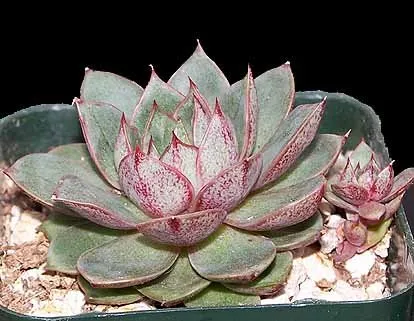
Description
Sowing dates
Propagation of these hybrids is primarily achieved through vegetative methods such as leaf cuttings or offsets. This ensures that the aesthetic characteristics of the hybrid are consistently preserved in the offspring.
When propagating via leaf cuttings, it is crucial to allow the wound to callous for several days before placing it on the substrate. This prevents fungal infections and ensures a higher success rate for root development.
Seed propagation is used for research and breeding new cultivars. Seeds require a well-draining, finely textured substrate and should be sown on the surface under high-humidity, controlled temperature conditions.
The optimal timeframe for active growth and propagation is from spring through early summer. During this period, light levels are sufficient to support rapid root formation and vigorous vegetative growth.
Young seedlings and recently rooted cuttings require gentle handling. They should be protected from direct intense sunlight during the first few weeks to avoid tissue desiccation while the root system is underdeveloped.
Growing requirements
These hybrids are members of the Crassulaceae family, displaying a distinct morphology that combines the stiff, spotted leaves of E. purpusiorum with the characteristic pubescence of E. setosa.
Success in cultivation relies heavily on providing a fast-draining, mineral-rich substrate. A standard mix typically includes pumice, coarse sand, and a minimal amount of organic peat or coconut coir.
The plants thrive in bright, indirect light. Proper light levels are essential to prevent etiolation and to maintain the compact, rosette-forming structure that gives the plant its ornamental value.
Watering must follow the "soak and dry" method. It is vital to let the soil dry out completely between waterings to simulate the plant's native arid climate and to prevent root rot.
Temperature management plays a key role in seasonal cycles. Ideally, the plants should be kept at 20-25°C during the day in summer and allowed a cooler, drier rest period around 10-15°C during the winter months.
Main diseases and pests
Root rot, caused by overwatering or poor drainage, is the primary threat. It is almost always fatal if not addressed early, leading to the rapid decay of the entire rosette base.
Mealybugs are frequent pests that congregate in the leaf axils. Their presence can be identified by a white, cottony substance, and they must be managed with systemic insecticides or targeted alcohol applications.
Fungal issues, such as leaf spot, can arise in stagnant, humid environments. Maintaining proper air circulation is the most effective way to prevent these pathogens from spreading through the collection.
Spider mites may occasionally infest the plants if the ambient air remains consistently dry for long periods. Regular inspections of the undersides of leaves are recommended to detect early infestations.
To maintain plant health, it is advised to avoid getting water directly into the center of the rosette. Moisture accumulation in the crown creates a perfect environment for bacterial and fungal infections.