
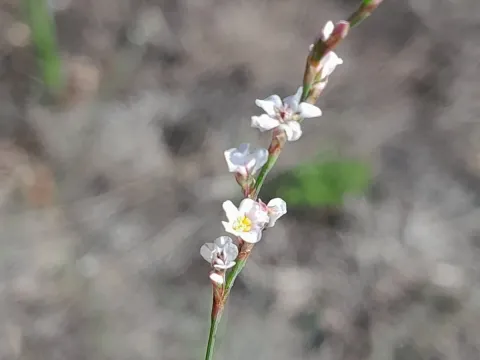
Sand knotweed
Polygonum arenarium
Sand knotweed (Polygonum arenarium) is a member of the Polygonaceae family. It is an annual herbaceous plant characterized by highly branched, prostrate stems that often spread along the ground.
What the section contains
Sand knotweed
The leaves are alternate, narrow, linear-lanceolate, and feature characteristic membranous ochreae at the base, which is a diagnostic feature of the entire family.
The flowers are small and arranged in loose, spikelike or paniculate inflorescences, displaying greenish-white to pinkish hues during their long blooming season.
It possesses a deep taproot system, which provides the plant with significant resistance to adverse environmental conditions, including prolonged drought.
The fruits are three-angled achenes that scatter easily upon maturity, facilitating efficient reproduction and dispersal across agricultural fields.
As the name suggests, this species thrives in sandy, loamy, and rocky soils, frequently colonizing wastelands, roadsides, and abandoned fields.
In agricultural settings, it commonly infests row crops, cereals, and vineyards, particularly in regions where light soil textures predominate.
Sand knotweed exhibits high ecological plasticity, allowing it to adapt quickly to intensive farming conditions and compete effectively with crop plants.
Mass germination is often triggered by shallow tillage, which brings dormant seeds from deeper soil layers to the active surface zone.
Due to its efficient seed dispersal mechanisms, the weed can rapidly colonize available spaces, forming dense clusters that displace desired crop seedlings.
Sand knotweed competes aggressively with crops for soil moisture and nutrients, which can severely hinder crop development during early growth stages.
The spreading nature of its stems creates dense mats that shade out crops, leading to inhibited photosynthesis and reduced overall biomass production.
Infestation by this weed complicates mechanical harvesting processes, leading to increased grain moisture levels and high impurity rates in harvested products.
The species serves as a potential reservoir for various plant pathogens and insect pests, which may subsequently migrate to infest cultivated crops.
The economic impact is manifested through reduced crop yields and the increased financial burden of post-harvest grain cleaning and sorting operations.
Strategic crop rotation is a fundamental management practice to prevent the long-term buildup of the seed bank in sandy soil environments.
Deep plowing remains an effective mechanical control measure, as it buries seeds to depths that prevent successful germination and emergence.
Regular inter-row cultivation in row crops is essential for eliminating young weeds before they reach the flowering stage and produce seeds.
Chemical control involving systemic herbicides is highly effective at destroying both the above-ground foliage and the underlying root system of the plant.
- Pre-sowing application of glyphosate-based herbicides;
- Use of selective herbicides during the active growth phase;
- Mowing of field margins to prevent the spread of seeds to crop areas.