
Skeletonweed
Eriogonum deflexum
Description
How to tell it apart
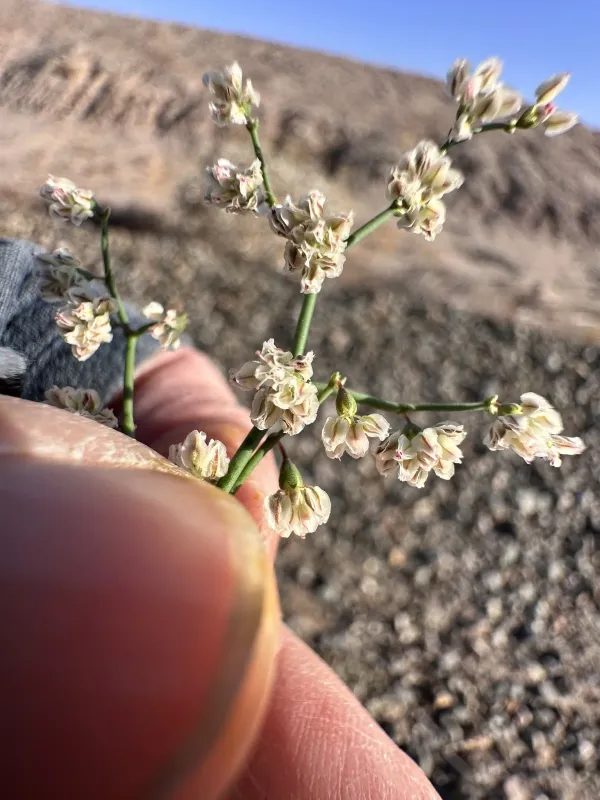
Eriogonum deflexum, commonly known as skeletonweed, is an annual herbaceous plant belonging to the Polygonaceae family. It is characterized by its sprawling, branching stems that often exhibit a reddish or brownish hue.
The leaves are primarily basal, arranged in a rosette at the base of the plant, featuring rounded or ovate shapes covered with a fine, woolly texture that aids in water retention.
Its inflorescences are distinct umbel-like heads found at the tips of the branches. The flowers are remarkably small, typically appearing white or pale pink during the flowering stage.
The root system is a deep taproot, which provides the plant with significant stability and access to deep-soil moisture, making it highly resilient in arid environments.
Reproduction is achieved entirely through seeds, which are produced in large numbers and are easily dispersed by wind and machinery across vast agricultural landscapes.
Where it grows
This species is native to the desert and arid regions of North America, including states such as California, Arizona, and Nevada, where it thrives in harsh conditions.
In agricultural settings, it is commonly found in disturbed soils, along fence lines, field margins, and fallow areas, where it acts as a reservoir for further invasion.
It prefers sandy, rocky, or nutrient-poor soils where competition from native grasses or crops is minimal, allowing it to establish dominance quickly.
The weed frequently infiltrates row crops and orchards, especially where soil cultivation practices are insufficient to disrupt its early development stages.
It is also a common inhabitant of overgrazed pastures, where the reduction of ground cover allows the plant to exploit available sunlight and moisture resources.
Harm it causes
The primary harm caused by skeletonweed is its aggressive competition with crop plants for water, particularly in dryland farming regions where moisture is the limiting factor for yield.
The plant's rapid growth rate allows it to shade young crop seedlings, stunting their development and leading to uneven stands that complicate harvest operations.
Contamination of the harvest by skeletonweed seeds reduces the overall quality of the grain, potentially leading to lower market prices or rejection by agricultural buyers.
It serves as an alternative host for various agricultural pests, increasing the pressure on crops and necessitating additional pesticide applications.
In pasture environments, it significantly reduces the carrying capacity of the land by displacing nutritious forage species with its unpalatable biomass.
How to control
Effective control starts with deep tillage or plowing, which is essential to destroy the root system and bury the plant before it reaches the reproductive stage.
Regular inter-row cultivation is highly recommended for row crops to prevent the establishment of seedlings and to disrupt the growth of established rosettes.
Chemical control involving systemic herbicides is most effective when applied during the early rosette stage, providing the best suppression before the plant hardens.
Implementing a crop rotation that includes competitive, dense-canopy crops helps shade out the weed and diminishes its population over successive seasons.
- Maintaining clean equipment to prevent seed dispersal between fields.
- Targeted herbicide application on field edges to halt encroachment.
- Monitoring irrigation systems to avoid localized moist spots where the weed flourishes.
Taxonomy
- Latin name
- Eriogonum deflexum
- Family
- Гречишка вьюнковая
- EPPO code
- ERGDE