
Prostrate knotweed
Persicaria prostrata
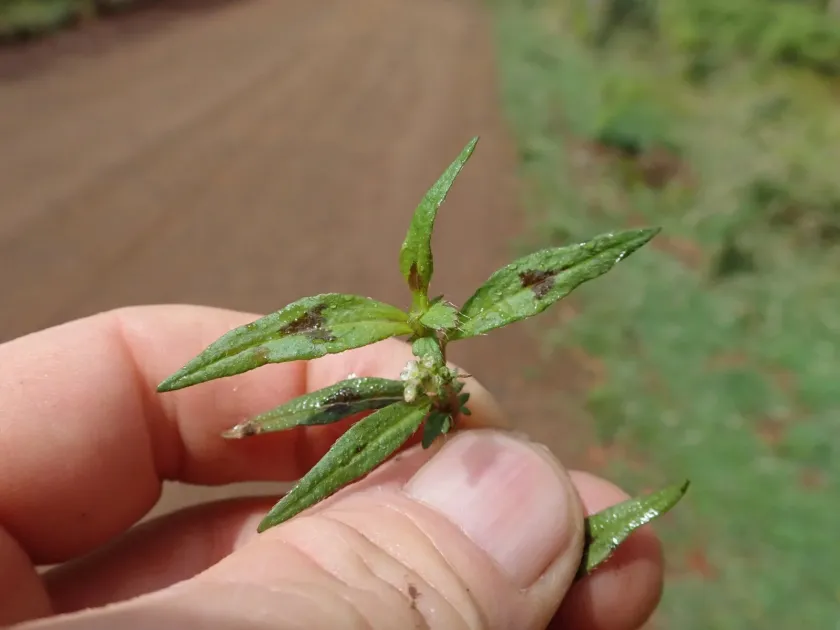
Description
How to tell it apart
Prostrate knotweed (Persicaria prostrata) is an annual herbaceous plant belonging to the Polygonaceae family. It is characterized by its prostrate stems that spread across the soil surface and often root at the nodes, forming dense mats.
The leaves are alternate, lanceolate or elliptical in shape, and often have a characteristic dark spot in the center. A key morphological feature is the ocrea—a thin, papery sheath that encircles the stem at the base of each leaf.
Flowers are small, typically pale pink or greenish-white, clustered in spike-like or head-like inflorescences at the tips of the stems. Blooming occurs throughout the summer, producing small seeds that can remain viable in the soil for years.
The root system is relatively shallow but robust, and the plant's ability to propagate vegetatively via rooting stems allows it to colonize bare soil areas quickly. This makes it a highly resilient weed in compacted environments.
It is easily distinguished from other knotweeds by its low-growing, mat-forming habit. In optimal conditions, it can cover large patches of ground, effectively outcompeting smaller or newly germinated crop seedlings.
Where it grows
Prostrate knotweed prefers compacted, moist, and nitrogen-rich soils. It is frequently found in field depressions, along the edges of agricultural plots, near irrigation ditches, and on compacted paths or roadsides.
In terms of agricultural impact, it is most troublesome in row crops like corn, sunflowers, and sugar beets. During the early stages of crop development, before the canopy closes, the weed can rapidly colonize inter-row spaces.
The weed thrives in areas with poor drainage or where soil surface compaction prevents healthy water infiltration. Its opportunistic nature allows it to establish quickly after rainfall in tilled fields where the topsoil is loose.
It also appears in thin or poorly established stands of cereal crops, where there is sufficient light penetration to support its growth. Its ability to tolerate short-term flooding makes it common in river valley farmlands.
Human activity is a primary vector for its dispersal; seeds and stem fragments are easily moved by agricultural machinery, creating new patches of the weed in clean fields during tillage and planting operations.
Harm it causes
The primary harm caused by prostrate knotweed is intense competition for nutrients, specifically nitrogen, and available soil moisture. By creating dense mats, it effectively shades the soil, depriving young crops of light.
In highly infested fields, crop yields can be significantly reduced due to the stunt in early development caused by the weed's competition. It acts as an early-season competitor that slows down the maturation of primary crops.
Prostrate knotweed serves as a host for various viral and fungal pathogens, which can then spread to cultivated crops. This increases the risk of disease incidence in fields where the weed is not managed properly.
The presence of this weed hampers the efficiency of agricultural machinery during cultivation and harvesting. Stem fragments can clog tillage tools, and the accumulation of biomass can interfere with the operation of combine headers.
Seed contamination is another major economic factor, as the small size of knotweed seeds makes them difficult to separate from many crop seeds during cleaning, leading to quality downgrades and financial losses.
How to control
Mechanical control through deep primary tillage is essential to bury seeds and prevent their emergence. In row crops, timely inter-row cultivation is highly effective at destroying young knotweed plants before they become established.
Crop rotation remains one of the best long-term management strategies. Rotating crops that develop a thick canopy early in the season can naturally suppress knotweed by limiting the light available for its growth.
Chemical control involving selective herbicides is effective when applied at the seedling or rosette stage. In non-crop areas or fallows, systemic herbicides like glyphosate are used to eliminate existing vegetation and reduce the seed bank.
- Promoting rapid crop emergence to outcompete the weed.
- Using post-emergence herbicides targeted at broadleaf weeds.
- Strict hygiene measures for agricultural equipment to prevent seed dispersal.
Post-harvest management, such as stubble cultivation, helps prevent late-season seed production. Monitoring fields in the early stages of crop development allows for localized spot treatments, preventing the weed from spreading across the entire field.
Taxonomy
- Latin name
- Persicaria prostrata
- Family
- Гречишка вьюнковая
- EPPO code
- POLPR