

Weed · affects Common poppy, Common hemp-nettle, Field forget-me-not
Prostrate knotweed
Polygonum arenastrum
Description
How to tell it apart
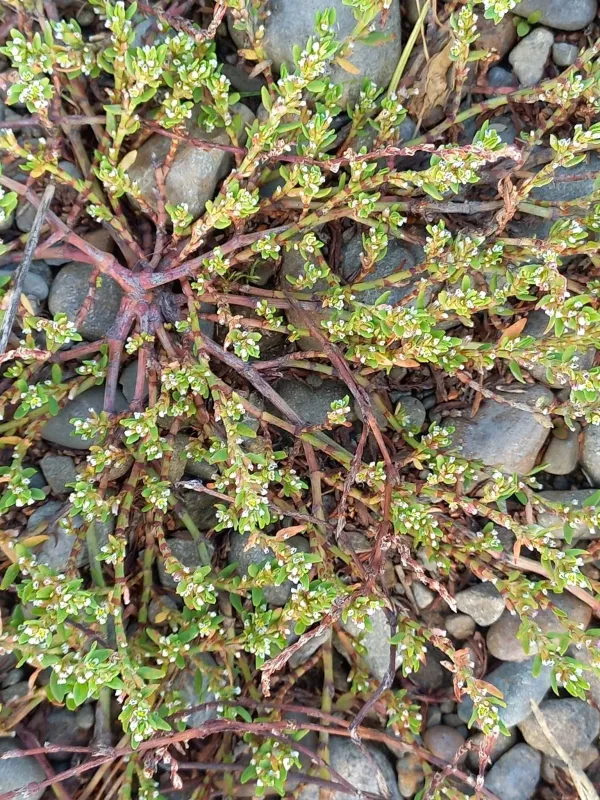
Prostrate knotweed, scientifically known as Polygonum arenastrum, belongs to the Polygonaceae family. It is an annual herbaceous weed characterized by a prostrate, mat-forming growth habit.
The stems are branched, often reaching lengths of up to 60 cm. They are tough, wiry, and flattened, radiating from a central taproot, often forming dense circular mats on the soil surface.
Leaves are small, elliptical to lanceolate, and alternate. A distinct feature of this plant is the white, papery sheath known as an ochrea that surrounds the stem at the base of each leaf.
The flowers are minuscule, greenish-white to pink, and clustered in the leaf axils. They are generally inconspicuous and possess no petals, yet they are highly efficient at seed production.
The seeds are small, three-sided, dark brown to black achenes. Due to their hard seed coat, they can remain dormant and viable in the soil for several years, ensuring persistent re-infestation.
Where it grows
Prostrate knotweed is a cosmopolitan weed that thrives in compacted soils, making it a common sight in heavily trafficked areas, farm lanes, and compacted field headlands.
It is exceptionally tolerant of foot traffic and heavy machinery, which explains its common presence in orchards, gardens, and along the edges of cultivated agricultural fields.
The plant prefers open, sunny locations with poor soil structure. It frequently colonizes areas where other vegetation has been removed or damaged by environmental stress.
In modern agricultural settings, it is a problematic weed in various crops, including cereals, row crops, and vegetable gardens, often appearing in gaps between crop rows.
Because of its ability to grow in very dry and compacted conditions, it can establish itself when crop stands are thin or when early-season moisture is limited.
Harm it causes
The primary harm caused by prostrate knotweed is its intense competition with crops for limited water and nutrient resources, particularly during the critical early stages of crop growth.
By forming dense mats on the soil surface, it effectively smothers young crop seedlings and intercepts sunlight, significantly hindering the development of the main crop stand.
Knotweed serves as a host for various insects and plant pathogens, including aphids and fungi, which can subsequently spread to the cultivated crop, increasing the need for pesticide application.
During harvest, the presence of knotweed mats can impede the efficiency of mechanical harvesters, leading to increased equipment wear and potential contamination of the harvested grain.
Furthermore, its presence reduces overall land productivity, as it displaces desirable vegetation in pastures and reduces the quality of the available forage for livestock.
How to control
Effective management begins with soil management practices, such as preventing excessive compaction and utilizing deep plowing to bury weed seeds and prevent their germination.
Cultural control includes competitive crop rotation. Planting high-density crops helps shade out knotweed, as the weed requires direct sunlight to thrive and spread its mats.
Mechanical control involves timely inter-row cultivation or harrowing in row crops. This should be performed while the plants are still in the seedling stage to be truly effective.
Chemical control options include the use of selective herbicides. For best results, applications should target the plants early in their growth stage, specifically the 2 to 4 true-leaf phase.
Because seeds persist in the soil, integrated weed management (IWM) strategies are necessary. This includes maintaining field hygiene and preventing seed production along the field edges.
Content graph
Connections · Prostrate knotweed
Most often together:
Marketplace
Products · 21




Cloquarid 300, EC, (Cloquarid, 300 g/l)
Schirm GmbH Division Sideco
Herbicides
0
0
·
29
3 offers
21.92 €per 1 l
Buy

Gerber
Superus Co., Ltd., Китай, Yangzhou Pioneer Chemical Co., Ltd., Китай
Herbicides
0
0
·
1.9K
No offers
—
Details


Contactwin
Finkemü Schwebda, F.GmbH, GERMANY, MEMBER OF GROUP
Herbicides
0
0
·
611
No offers
—
Details


Arena, c.s., (Etofemezat, 500 g/l)
«Юнісіті Ентерпрайсіс Л.П.», Единбург, Великобританія
Herbicides
0
0
·
36
No offers
—
Details

Biology
Taxonomy
- Latin name
- Polygonum arenastrum
- Family
- Гречишка вьюнковая
- EPPO code
- POLAR