
Sea knotweed
Polygonum glaucum
Description
How to tell it apart
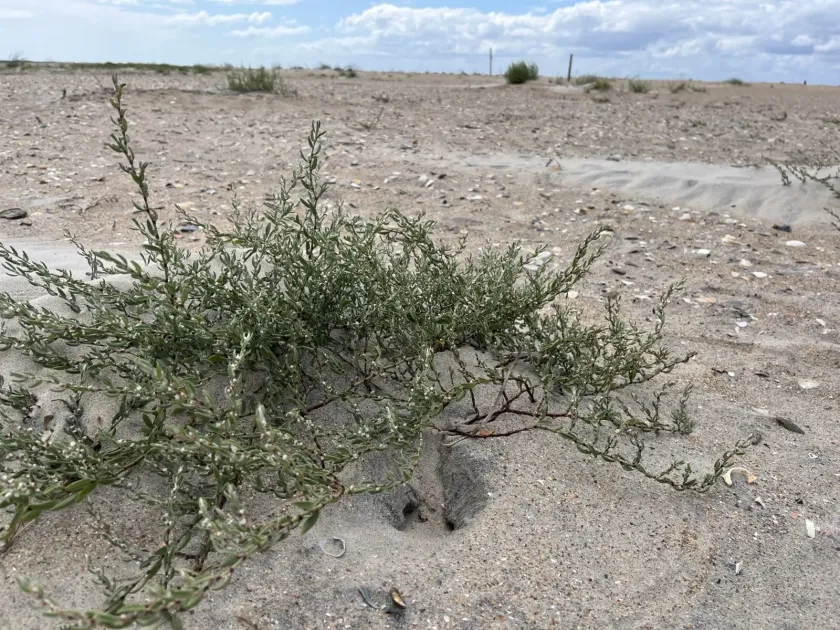
Sea knotweed (Polygonum glaucum) belongs to the Polygonaceae family. It is an annual herbaceous plant characterized by spreading or prostrate stems that branch significantly from the base.
The leaves have a distinctive glaucous or greyish-green color, often coated with a thin waxy layer, which gives the plant its common and scientific name. This visual appearance makes it distinct from other common knotweed species.
The flowers are small and arranged in axillary inflorescences. They typically range in color from white to pale pink. The flowering period is prolonged, which ensures the plant remains highly reproductive throughout the summer.
Its root system is taproot-based, allowing the plant to reach deeper moisture levels, making it resilient in sandy and dry environments.
Like many species in its family, it produces hard-coated seeds that can persist in the soil seed bank for several years, ensuring the plant's survival across multiple growing seasons.
Where it grows
Sea knotweed is primarily found in coastal habitats, including sandy beaches, dunes, and shingle banks. It is well-adapted to environments with high light intensity and shifting substrates.
In agricultural settings, this weed is most problematic in fields near coastal areas or in regions with sandy, low-nutrient soils where competition for resources is high.
It thrives in disturbed areas such as roadsides, construction sites, and waste grounds. It is also known to tolerate moderate salinity, allowing it to grow where other weeds struggle.
Human activity, including the movement of vehicles and agricultural equipment, is a major vector for the spread of its seeds into new areas.
The plant prefers open, non-shaded conditions. In crops, it quickly colonizes gaps in the canopy, taking advantage of open soil surface to establish its sprawling growth.
Harm it causes
The primary agricultural impact of Sea knotweed is its role as a strong competitor for water and soil nutrients, particularly during the early establishment phase of crops.
The prostrate growth habit allows the plant to form dense mats that physically suppress the growth of crop seedlings by limiting their access to direct sunlight.
Sea knotweed can act as an alternative host for various plant pathogens and insect pests, which can facilitate the spread of diseases within the agricultural field.
High levels of infestation interfere with mechanical field operations, potentially causing damage to equipment or reducing the overall speed and efficiency of harvest.
Beyond crop competition, the presence of these weeds reduces the quality of harvested produce due to the contamination of seeds with weed debris, often necessitating costly cleaning procedures.
How to control
Integrated weed management is crucial for Sea knotweed control. Crop rotation and competitive crop varieties help shade out the weed and limit its ability to photosynthesize effectively.
Mechanical control through deep tillage and timely inter-row cultivation is highly effective at destroying young plants before they produce seeds.
Chemical control can be achieved through pre-emergent or post-emergent herbicides, depending on the crop and the weed's growth stage. Targeted applications are most effective.
Sanitation practices, such as cleaning machinery after working in infested zones, are essential to prevent the spread of seeds into cleaner parts of the farm.
- Promoting rapid crop canopy closure to suppress weed development.
- Using soil-applied herbicides to target the germination process.
- Maintaining field margins to reduce external seed sources.
- Monitoring fields periodically to address new patches before they mature.
Taxonomy
- Latin name
- Polygonum glaucum
- Family
- Гречишка вьюнковая
- EPPO code
- POLGL