
Small knotweed
Polygonum plebeium
Description
How to tell it apart
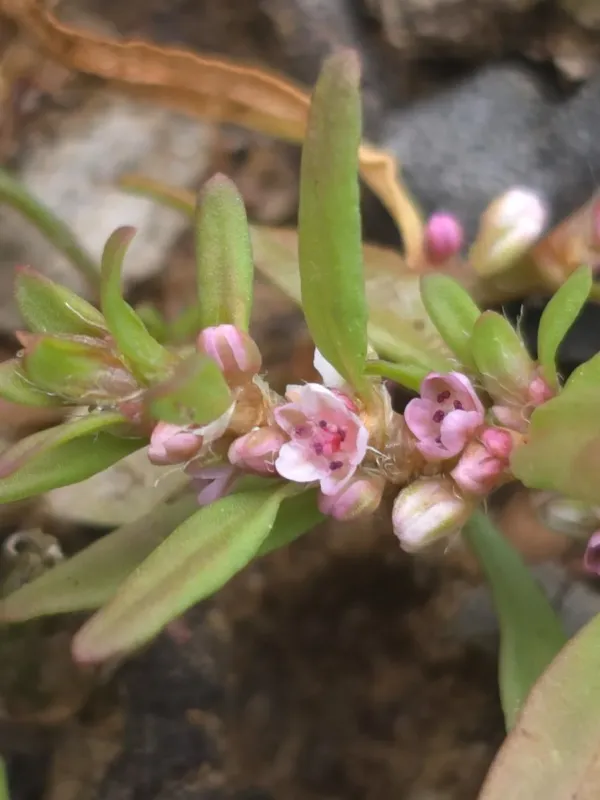
Small knotweed (Polygonum plebeium) belongs to the Polygonaceae family and is an annual herbaceous plant characterized by its prostrate or creeping stems. It often forms dense, low-growing mats on the soil surface.
The stems are highly branched from the base, giving the plant a spreading habit. The leaves are narrow, lanceolate, or linear, and possess characteristic membranous ocreas at the base of the petioles, which is a diagnostic feature of this family.
The flowers are extremely small, solitary or clustered in leaf axils. The perianth is usually pinkish or greenish, making the plant inconspicuous against the soil background.
The root system is a well-developed taproot that anchors the plant firmly in the soil. The seeds are small and triangular, retaining high viability in the soil seed bank for several years.
Small knotweed displays significant ecological plasticity, allowing it to adapt to various soil types, including those that are compacted or moderately saline.
Where it grows
This weed is widely distributed in fields, orchards, along roadsides, and in damp pastures. It frequently occurs in row crop fields where the lack of canopy closure provides sufficient light for its rapid establishment.
Small knotweed prefers areas with adequate moisture levels, making it a common problem in low-lying fields or near irrigation ditches. It can tolerate short-term flooding better than many other weed species.
It impacts cereal, pulse, and vegetable crops, especially during the early developmental stages. Due to its prostrate growth, it effectively competes with crops, creating a dense layer that shades the soil.
The plant is a common component of ruderal communities, quickly colonizing wasteland and disturbed sites. It often serves as an indicator of compacted soils subjected to intensive grazing or mechanical traffic.
Active vegetation lasts from late spring to autumn, with new flushes of seedlings occurring throughout the summer, which complicates control efforts.
Harm it causes
The main harm caused by small knotweed is the intensive depletion of soil moisture and nutrients, which significantly reduces the yield potential of the primary crop. Its strong root system makes it a highly efficient competitor.
The prostrate growth habit creates obstacles for mechanized harvesting. Dense patches of the weed can clog agricultural machinery, leading to operational downtime and maintenance issues.
The plant acts as an alternate host for several fungal and viral diseases that can eventually spread to crop plants, increasing the phytosanitary risks on the field.
High seed productivity allows the weed to quickly accumulate a significant seed bank in the topsoil. Even a few individuals can lead to severe infestation under favorable conditions.
In perennial forage crops, small knotweed can lead to stand thinning, outcompeting desirable forage species due to its aggressive growth and adaptability.
How to control
Agronomic control methods include regular inter-row cultivation in row crops, which effectively destroys the root zone of the small knotweed and prevents its re-establishment.
Crop rotation is essential, as continuous monocropping facilitates the accumulation of the weed's seed bank in the soil. Integrating crops with different growth cycles is recommended to disrupt the weed's life cycle.
Chemical control involves the application of broad-spectrum herbicides during the active growth phase, prior to flowering. Sulfonylureas or glyphosate-based treatments (in pre-planting scenarios) have shown efficacy.
Stubble cultivation immediately after harvest is a vital practice, as it stimulates the germination of weed seeds, allowing the resulting seedlings to be destroyed by subsequent tillage.
- Stimulating seed germination before crop planting.
- Thorough harrowing to eliminate young weed seedlings.
- Timely nitrogen application to boost crop vigor.
- Using high-quality, weed-free crop seeds.
Taxonomy
- Latin name
- Polygonum plebeium
- Family
- Гречишка вьюнковая
- EPPO code
- POLPB