
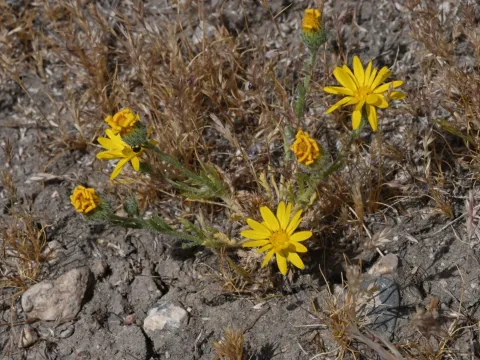
Slender goldenweed
Xanthisma gracile
Slender goldenweed (Xanthisma gracile) is an annual herbaceous plant belonging to the Asteraceae family, well-adapted to arid and semi-arid environments.
What the section contains
Slender goldenweed
The plant typically grows with a slender, branching stem reaching heights of 20 to 60 cm, covered with narrow, linear or lanceolate leaves arranged alternately.
Its flowering structures are comprised of small, bright yellow flower heads (capitula) located at the terminal ends of the branches, characteristic of the tribe Astereae.
The root system is characterized by a deep taproot, which allows the plant to access deep soil moisture, making it highly competitive during drought periods.
Reproduction is solely through seeds, which are produced in large quantities and are easily dispersed by wind, allowing for rapid colonization of disturbed areas.
The primary range of Xanthisma gracile is in the southwestern United States and northern Mexico, where it thrives in dry, open habitats.
It is commonly found in overgrazed rangelands, roadside verges, abandoned agricultural fields, and areas where the topsoil has been physically disturbed.
In farming systems, it is most troublesome in fields with low plant density, where the crop canopy fails to close and suppress invading weeds.
The weed favors sunny, dry conditions and is capable of thriving in various soil types, ranging from sandy to heavier, well-drained loamy soils.
Its opportunistic nature allows it to quickly establish in fallow fields, building a significant soil seed bank that can last for multiple seasons.
The primary agricultural impact of slender goldenweed is its intense competition for soil moisture and nutrients, which often leads to reduced crop yields.
By shading the crop and extracting resources, it significantly slows down the development of sensitive young plants during the early vegetative stages.
The presence of this weed in harvestable produce can lead to dockage at elevators and complicate the processing of grain due to its tough, fibrous stems.
The plant can act as an alternative host for various pests and diseases, creating a reservoir that can reinfect crops throughout the growing season.
On rangelands, it often replaces preferred palatable forage species, thereby reducing the carrying capacity of the land for livestock production.
Deep tillage is an effective mechanical method to bury seeds and prevent the emergence of new seedlings by placing them at non-viable depths.
Crop rotation with competitive, dense-canopy crops is recommended to provide natural suppression through shading and efficient nutrient uptake.
Post-emergence chemical control using broadleaf-specific herbicides is highly effective when applied during the early vegetative stage before flowering begins.
Mechanical cultivation between rows in row crops is essential to uproot young plants and prevent the plant from producing viable seeds for the next year.
Integrated Weed Management (IWM) strategies should focus on maintaining healthy crop stands to deny the weed the light and space it requires to establish.