
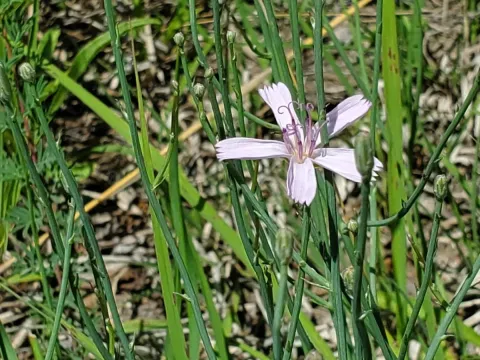
Skeletonweed
Lygodesmia juncea
Skeletonweed (Lygodesmia juncea) is a perennial, deep-rooted member of the Asteraceae family. It is notorious for its highly adapted structure, which allows it to thrive in harsh environments.
What the section contains
Skeletonweed
The plant is easily identified by its stiff, green, leafless, or sparse-leaved stems that branch out in a broom-like fashion. Its nickname, skeletonweed, derives from this skeletal appearance.
Flowers are small, solitary, and pink to lavender in color, appearing at the tips of the branches. The plant typically blooms from mid-summer until late autumn.
The most critical component of this weed is its extensive, aggressive root system. It produces deep vertical taproots that can reach depths of 2 meters or more.
Furthermore, the horizontal rhizomes create an interconnected underground network. This structure allows the plant to produce new shoots even after the surface growth has been destroyed.
Skeletonweed is widely distributed across the Great Plains and prairie regions of North America. It prefers dry, well-drained soils and is highly drought-tolerant.
It frequently infests agricultural lands, including cereal and pulse crops. It is also commonly found in pastures, rangelands, and along roadsides where competition is low.
Due to its ability to sprout from root fragments, it thrives in fields with minimal tillage systems or where mechanical disturbance is frequent but not deep enough to destroy the taproot.
The plant adapts well to degraded soil conditions and can persist in fields that have been left uncultivated for several years, forming dense monocultures.
Its natural affinity for arid environments makes it an incredibly difficult weed to eradicate in regions with low seasonal rainfall and limited irrigation resources.
The primary impact of skeletonweed is its role as a strong competitor for soil moisture and nutrients. Its deep roots access water long before crop roots, depriving wheat and other grains.
This resource depletion results in significant yield losses, particularly during dry growing seasons when crops are most vulnerable to moisture stress.
During harvest, the rigid, tangled stems of the weed can clog machinery, leading to operational delays, increased fuel consumption, and higher wear on equipment.
Skeletonweed acts as a reservoir for various agricultural pests and viral pathogens, creating a continuous cycle of infection that can spread to cultivated crops.
The encroachment of this weed into pastures reduces the biomass available for livestock grazing, as it replaces more palatable and nutritionally valuable forage species.
Controlling skeletonweed is difficult due to its deep root reserves. Successful management requires a multi-year strategy focused on exhausting the plant's energy.
Chemical control via systemic herbicides is the most effective approach. Applications should be timed during active growth stages, ensuring the chemical is translocated to the roots.
Cultural practices, such as competitive cropping, help suppress growth. Planting crops that establish a dense canopy can reduce the light availability for the weed.
Tillage must be managed carefully; shallow cultivation can encourage the spread of root fragments, so deeper, precise tillage or chemical fallow is preferred.
- Systemic herbicide application during the late bud or flowering stage.
- Consistent suppression of foliage to deplete root energy reserves.
- Rotation with dense, competitive forage or pulse crops.
- Integrated pest management to reduce the spread of associated pathogens.