
Sneezewort
Achillea ptarmica
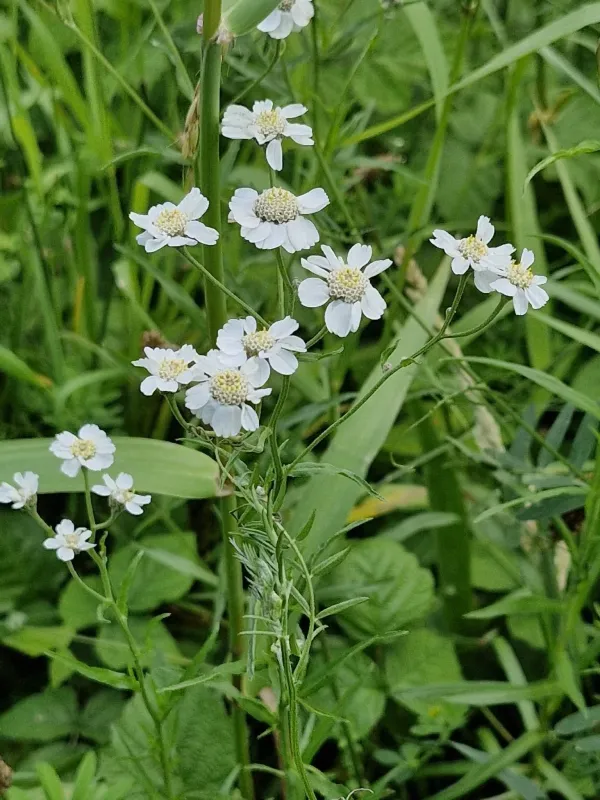
Description
How to tell it apart
Sneezewort (Achillea ptarmica) is a perennial herbaceous plant belonging to the Asteraceae family. It is distinct for its creeping rhizomes and erect stems reaching up to 60–80 cm in height.
The leaves are narrow, lance-shaped, and sharply serrated along the margins. Unlike the common yarrow, the leaves of this species are usually smooth and bright green.
The inflorescence consists of loose corymbs with white, button-like flower heads. These flowers are relatively large and bloom from mid-summer into early autumn.
The plant is known for its ability to irritate the nose, causing sneezing when crushed, which is the origin of its common English name.
Its rhizomatous root system is highly persistent, allowing the plant to form dense colonies that are difficult to eradicate once established.
Where it grows
Sneezewort thrives in moist to wet soil conditions. It is typically found in damp meadows, marshes, along riverbanks, and in waterlogged low-lying areas.
In agricultural settings, it frequently colonizes poorly drained fields, irrigation ditch banks, and damp headlands where water accumulates.
It is often found in permanent pastures and hayfields, where it can become an invasive component of the sward if the moisture level remains high.
The species is highly adaptable and can survive in various soil types, provided that adequate moisture levels are maintained throughout the growing season.
Due to the combination of wind-dispersed seeds and vegetative spread via underground rhizomes, it can rapidly colonize adjacent agricultural land.
Harm it causes
The primary agricultural impact of sneezewort is crop yield suppression due to its aggressive competition for space, moisture, and essential soil nutrients.
It is considered a detrimental weed in hay production because it is unpalatable to livestock, which significantly reduces the quality and market value of the fodder.
Heavy infestations can impede mechanical harvesting operations, as the thick, resilient stems can interfere with the efficiency of combine harvesters.
Sneezewort acts as an alternative host for several pests and fungal pathogens, potentially facilitating the spread of diseases to surrounding primary crops.
Its deep and extensive root system makes it highly resilient to shallow tillage, leading to increased labor and fuel costs for repeated soil management.
How to control
Improved field drainage is the most effective long-term strategy, as reducing soil moisture makes the environment less hospitable to this moisture-loving species.
Deep plowing and regular cultivation help to break up and weaken the rhizomatous root network, provided these practices are performed consistently.
Strategic crop rotation with highly competitive, fast-growing crops can help shade out the weed and limit its spread during the active growing phase.
Chemical control using systemic glyphosate-based herbicides is recommended in post-harvest or pre-seeding stages to ensure deep translocation into the rhizomes.
- Timely mowing before the onset of flowering to stop seed production.
- Application of selective herbicides in accordance with local regulations.
- Strict equipment cleaning protocols to prevent the transport of root fragments.
Taxonomy
- Latin name
- Achillea ptarmica
- Family
- Сложноцветные (астровые)
- EPPO code
- ACHPT