
Slender tarweed
Madia gracilis
Description
How to tell it apart
Slender tarweed (Madia gracilis) belongs to the Asteraceae family. It is an annual herbaceous plant with a straight, often branched stem that typically grows to a height of 20 to 80 centimeters.
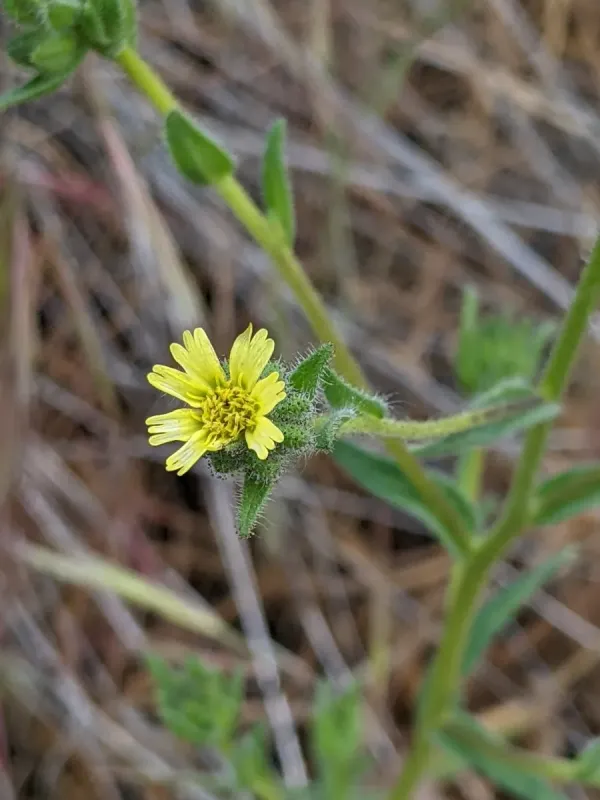
A key characteristic of this species is the presence of glandular hairs on the stem and leaves, which make the plant feel sticky or tacky to the touch. The plant emits a distinct, resinous, aromatic scent.
The leaves are alternate, linear or lanceolate in shape, and often lack teeth or have very fine, sparse serrations along the margins.
The flowers are arranged in small heads grouped into loose terminal clusters. The involucral bracts surrounding the heads are densely covered with the aforementioned glandular hairs.
The seeds, known as achenes, are small and slightly flattened. They are typically dark brown or black, contributing to their high capacity for soil contamination and distribution.
Where it grows
This species thrives in open areas with plenty of sunlight. It is frequently found in pastures, along roadsides, field margins, and on abandoned or fallow agricultural land.
In cultivated fields, it primarily competes with cereal crops, row crops, and perennial grasses for water, sunlight, and soil nutrients.
The plant is highly adaptable to various soil types, including dry or sandy conditions, which allows it to spread rapidly across disturbed lands.
Dissemination occurs primarily through wind and water, as well as via agricultural machinery, which transports seeds from infested areas to clean fields.
Slender tarweed quickly colonizes open patches after harvest, effectively building up a substantial seed bank for subsequent cropping cycles.
Harm it causes
Slender tarweed causes significant yield losses by aggressively competing with crops for limited water and mineral resources during the peak growing season.
The sticky, glandular nature of the plant can cause significant operational issues during harvest, as the plant material clogs the internal mechanisms of combines and headers.
Contamination of the harvested grain with tarweed seed and vegetative material increases grain moisture content, complicating cleaning, drying, and storage.
When present in high densities during the early stages of crop development, it suppresses the growth of the crop, leading to reduced plant stands and uneven development.
Its presence in forage areas reduces the quality and palatability of hay or pasture, as livestock tend to avoid the resinous and bitter foliage of the plant.
How to control
Implementing a robust crop rotation is essential, as it disrupts the life cycle of the weed and prevents the buildup of the seed bank through diversified tillage practices.
Deep primary tillage, such as plowing with moldboard turnover, is effective in burying seeds deep in the soil profile, preventing successful germination.
Timely mechanical weeding, including inter-row cultivation in row crops, should be performed before the canopy closes to effectively suppress weed growth.
Chemical control using selective herbicides is most effective when applied during the early growth stages of the weed, particularly in cereal crops at the tillering stage.
- Maintain optimal crop seeding rates.
- Clear field borders and surrounding areas of weed populations.
- Use certified, clean, and weed-free seed for planting.
Taxonomy
- Latin name
- Madia gracilis
- Family
- Сложноцветные (астровые)
- EPPO code
- MADGR