
Sneezeweed
Helenium autumnale
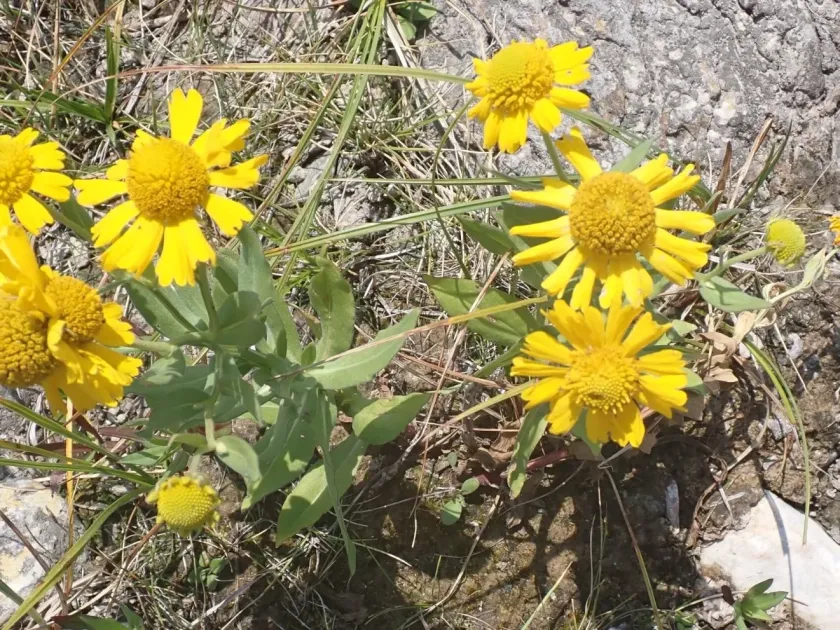
Description
How to tell it apart
Sneezeweed (Helenium autumnale) is a perennial herbaceous plant belonging to the Asteraceae family. It is characterized by its stiff, winged stems that can reach heights of up to 1.5 meters.
The leaves are alternate, lance-shaped, and feature finely serrated margins. The root system is robust and fibrous, anchoring the plant firmly in moist substrates.
The flower heads are gathered in terminal, corymb-like panicles. The ray florets are typically bright yellow and reflexed, while the central disk is prominent and globe-shaped.
The plant possesses a bitter taste and a distinct odor, which is attributed to sesquiterpene lactones present in its tissues, acting as a natural defense mechanism.
Flowering occurs in late summer through autumn, making the weed highly visible during the harvest season when other vegetation has matured.
Where it grows
Sneezeweed thrives in moisture-rich environments. It is naturally found in floodplains, wet meadows, along stream banks, and in poorly drained, boggy depressions.
In agricultural settings, it frequently infests pastures and hay fields, especially in areas where low-lying topography causes persistent water accumulation after rainfall.
It adapts well to heavy clay soils that retain moisture, creating ideal conditions for its establishment and expansion across open fields.
The plant often spreads into cultivation from adjacent wetlands or unmanaged drainage ditches, slowly encroaching on agricultural productivity.
As a perennial species, once established, it forms dense colonies that become permanent obstacles to standard field operations.
Harm it causes
The primary concern regarding Sneezeweed is its toxicity to livestock. Ingestion of the plant by cattle, sheep, or horses can result in poisoning, often referred to as "spewing sickness."
As a competitive weed, it siphons off water and essential nutrients, significantly reducing the biomass and overall health of desired forage crops.
The presence of this weed in hay reduces the market value and safety of the product, necessitating rigorous inspection and cleaning to prevent livestock health issues.
Persistent infestations degrade pasture quality, forcing farmers to reduce stocking rates or undertake costly land restoration measures to reclaim the acreage.
High seed production ensures that the weed remains a constant threat, capable of colonizing new areas if management practices are not consistently applied.
How to control
Systematic mowing before the plant reaches the seed-setting stage is a vital mechanical control method to deplete root energy reserves over several seasons.
Improving field drainage is highly effective in making the habitat less suitable for Sneezeweed, thereby reducing its competitive advantage over beneficial crops.
Chemical control using systemic herbicides, particularly those targeting broadleaf perennials, provides significant results when applied at the appropriate growth stage.
- Deep plowing to bury rhizomes and disrupt established colonies.
- Crop rotation to break the weed's life cycle.
- Spot-spraying or broadcast herbicide application in pastures.
Proactive management and continuous monitoring are essential to prevent the spread of Sneezeweed, ensuring pasture longevity and livestock health safety.
Taxonomy
- Latin name
- Helenium autumnale
- Family
- Сложноцветные (астровые)
- EPPO code
- HENAP