
Soliva
Soliva
Description
How to tell it apart
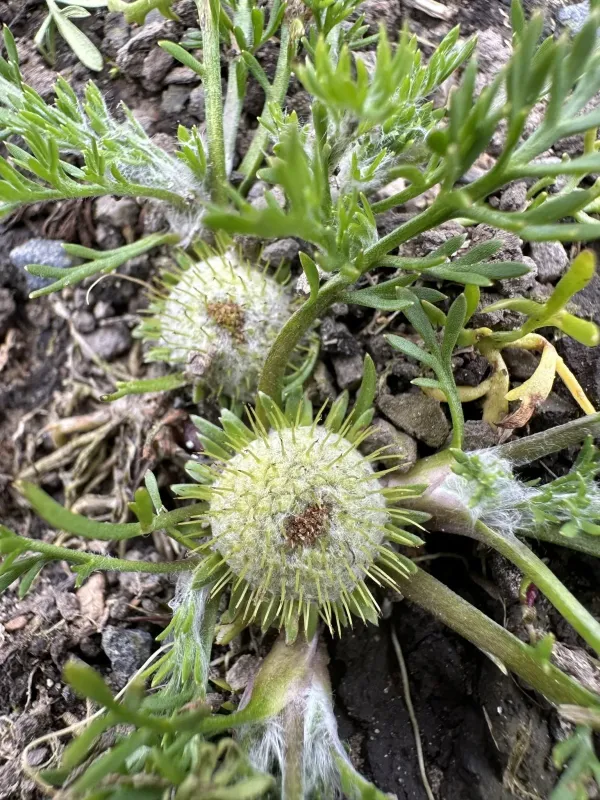
Soliva is a genus of annual herbs belonging to the Asteraceae family. These small, low-growing plants typically form a prostrate rosette of finely divided, fern-like leaves.
The most distinctive characteristic of Soliva is its fruit, which forms a dense, spiky burr at the center of the rosette. These sharp spines are designed to attach to animals or shoes.
The stems are very short, often making the plant appear stemless as the flowers and seeds develop almost directly at ground level.
Leaves are usually alternate, pinnately lobed, and can vary in color from light to deep green depending on soil moisture levels.
Propagation is strictly through seeds, which can persist in the soil for several seasons, waiting for favorable conditions to germinate.
Where it grows
Soliva thrives in areas with disturbed soil, often colonizing lawns, pastures, roadsides, and cultivated fields where competition is limited.
In agricultural settings, it is commonly found in forage crops and perennial grass fields, where it can easily establish itself in open patches.
It prefers compacted soils and is highly tolerant of grazing pressure and trampling, making it a persistent weed in livestock areas.
The plant is well-adapted to mild climates and often appears early in the season, quickly outcompeting slower-growing grasses.
It is frequently spotted in areas with poor drainage or where the turf density has been compromised by overgrazing or disease.
Harm it causes
The primary concern with Soliva is its spiky seeds, which can cause significant irritation and injury to the mouths and nostrils of grazing livestock.
As an aggressive weed, it competes with desired crops for water, sunlight, and soil nutrients, reducing the overall biomass of the field.
Its presence in hay or forage can decrease market value, as farmers must deal with the contamination of spiky seeds in the harvested product.
On recreational turf, Soliva is considered a nuisance because the burs make the area uncomfortable and dangerous for walking barefoot.
Uncontrolled growth can lead to permanent displacement of native grasses or intended forage species, causing long-term degradation of land.
How to control
Cultural control involves maintaining a dense and healthy canopy of desirable plants, which shades out Soliva and prevents seedling establishment.
Regular mowing before the burs harden is crucial to disrupt the plant's life cycle and reduce the build-up of the seed bank.
Chemical control should be applied during the early growth stages, specifically when the plants are still in the vegetative rosette phase.
For large infestations, selective herbicides that target broadleaf weeds are effective, provided they are applied according to crop safety guidelines.
- Monitor fields early in the season for rosette formation.
- Implement proper grazing rotation to keep turf dense.
- Apply post-emergence herbicides before the flowering period.
- Practice soil aeration and overseeding to strengthen competing grasses.
Taxonomy
- Latin name
- Soliva
- Family
- Сложноцветные (астровые)
- EPPO code
- SOVSS